

City Cast DC logo
Advertisement image

How DC Violence Interrupters Focus on Prevention Instead of Enforcement

Posted on September 19, 2024   |   Updated on September 30, 2025
Adrian González

Adrian González

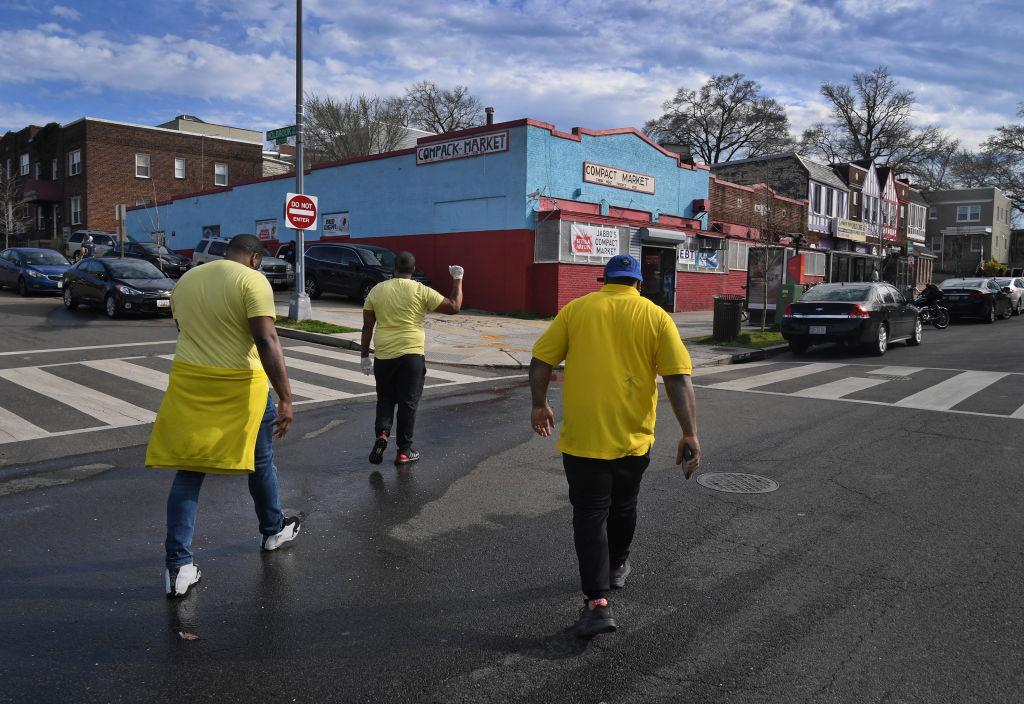
Three people in yellow shirts walk towards a convenience store.

Three members of the Cure the Streets team in Northeast Washington, D.C. (Michael S. Williamson/The Washington Post via Getty)

City Cast

What Do DC’s Violence Interrupters Do?

00:00:00

Violence intervention programs are just one of the strategies the D.C. government deploys in its fight against crime, placing the focus on prevention rather than enforcement. So, what exactly do violence interrupters do and how is their work evaluated?

What A Violence Interrupter Does

As part of these programs, violence interrupters provide an alternative to police departments in communities most at risk for violence. A trained interrupter works directly with residents to resolve person-to-person disputes before they lead to further altercation or shootings.

Interrupters can also intervene after an incident to help prevent retaliation and further conflict.

Why DC Needs Violence Interrupters

According to crime data from the Metropolitan Police Department, there were 274 homicides in D.C. in 2023 — a 36% increase from the previous year, and a 20-year high. While gun violence happens across the city, the impact is felt disproportionately in lower-income areas like Wards 7 and 8.

MPD typically gets involved after a crime has taken place, and enforcement tactics have faced mounting scrutiny. Violence intervention programs are designed to be a community-driven liaison to combat gun violence in neighborhoods that need it most, before conflict escalates.

Do Violence Interrupters Work?

It’s hard to know! The D.C. Police Union recently asked that D.C.’s violence interruption programs be shut down and examined. But our podcast guest Dr. Joseph Richardson credited Baltimore’s falling crime rate, in part at least, to its similar crime intervention program.

While law enforcement statistics like crime rates and police arrests are historically easier to quantify, crime prevention requires years of difficult work, community trust, and long-term data analysis. There is no single cause of crime, and no singular strategy to combat it.

It’s also worth noting that there are two separate crime intervention programs in D.C. Cure the Streets is under the Office of the Attorney General and uses the standard model for street outreach. Then, there’s the Violence Intervention Initiative, which is under the Office of Neighborhood Safety and Engagement and has discretion to use its own models. Two programs operating independently from each other adds to the difficulty of measuring success.

Given the complexity of these programs, the city is constantly reevaluating how they work and how to improve them. The City Cast DC podcast sat down with one man helping with that research.


🎧 How The City Is Assessing Its Violence Interrupters

Share article

Hey DC

Get smart about D.C. with our news roundup and analysis.

Can't subscribe? Turn off your ad blocker and try again.
Advertisement image

Local Civics

See All
Local CivicsApril 13

Why the Holocaust Museum Self-Censored Before Trump Even Asked

The Holocaust Museum has been quietly changing its content since President Trump returned to office to avoid drawing the administration’s...

The United States Holocaust Memorial Museum. (ajay_suresh/Wikimedia Commons)
Local CivicsMarch 25

Malcolm X Park Closure Sparks Community Outcry

Most of Malcolm X Park is closing until early summer for repairs. Here is everything we know so you can plan your picnic in peace.

Enjoying the park before it closes. (Kaela Cote-Stemmermann/City Cast DC)
Local CivicsMarch 16

In Controversial Move, FBI Sends New Grads to Patrol DC

The FBI just announced that it's sending its upcoming agent class from Quantico to do a 60-day foot patrol rotation in D.C. alongside loc...

FBI officers seen walking in LeDroit Park. (The Washington Post/Getty Images)
Local CivicsMarch 9

The McMillan Development Is Finally Here — Will It Live Up To the Hype?

For more than a decade the McMillan filtration site was one of D.C.’s ugliest political battles. Now, the redevelopment is here, but will...

A new housing development at the old McMillan site in Washington, DC (The Washington Post/Getty Images)
Local CivicsFebruary 26

The Downfall of DC's Compass Coffee

Last week, British coffee chain Caffè Nero bought Compass Coffee at auction after it went bankrupt.

Outside of a Compass Coffee at 650 F. (The Washington Post/Getty Images)
Local CivicsFebruary 5

Jeff Bezos Gutted the Washington Post. Now What?

The Post, owned by Jeff Bezos, laid off up to a third of its staff.

Washington Post building located on K Street NW. (The Washington Post/Getty Images)
Local CivicsFebruary 2

Eleanor Holmes Norton’s Son Also Wanted Her to Retire

D.C.’s Congressional Delegate Eleanor Holmes Norton announced last week that she’s not going to run again.

Eleanor Holmes Norton speaks during a press conference about the deployment of the National Guard. (The Washington Post/Getty Images)
Local CivicsJanuary 29

Can the Kennedy Center Survive Trump?

This week, Composer Philip Glass, a 2018 Kennedy Center honoree renowned for his pioneering contributions to modern music, announced he n...

US President Donald Trump sits at the center of a long table and presides over a board meeting at the John F. Kennedy Center for the Performing Arts in Washington, DC, on March 17, 2025. He is surrounded by five people on each side.