

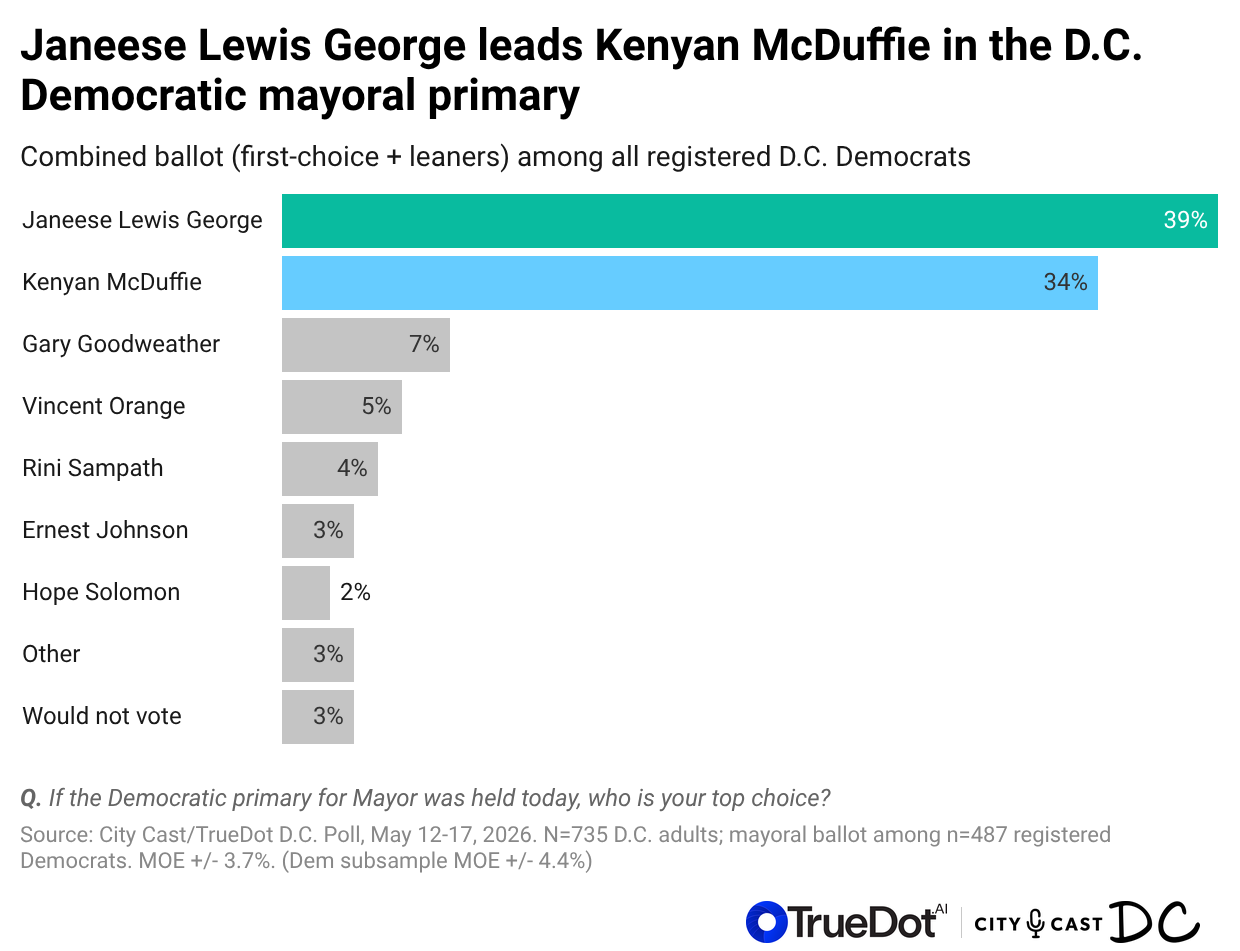
Janeese Lewis George holds a slim lead over Kenyan McDuffie, according to City Cast’s new poll of District residents. But the results also suggest that her lead might not hold up once second-choice votes are tabulated under the city’s new ranked-choice voting system — setting Washington up for a dramatic aftermath to the June 16 primary election.
According to the poll, the first citywide public poll in the most hotly contested race in a generation, Lewis George is the first choice of 39 percent of Democratic voters, five points above rival McDuffie. No other candidate tops 7 percent and 24 percent said they were undecided.
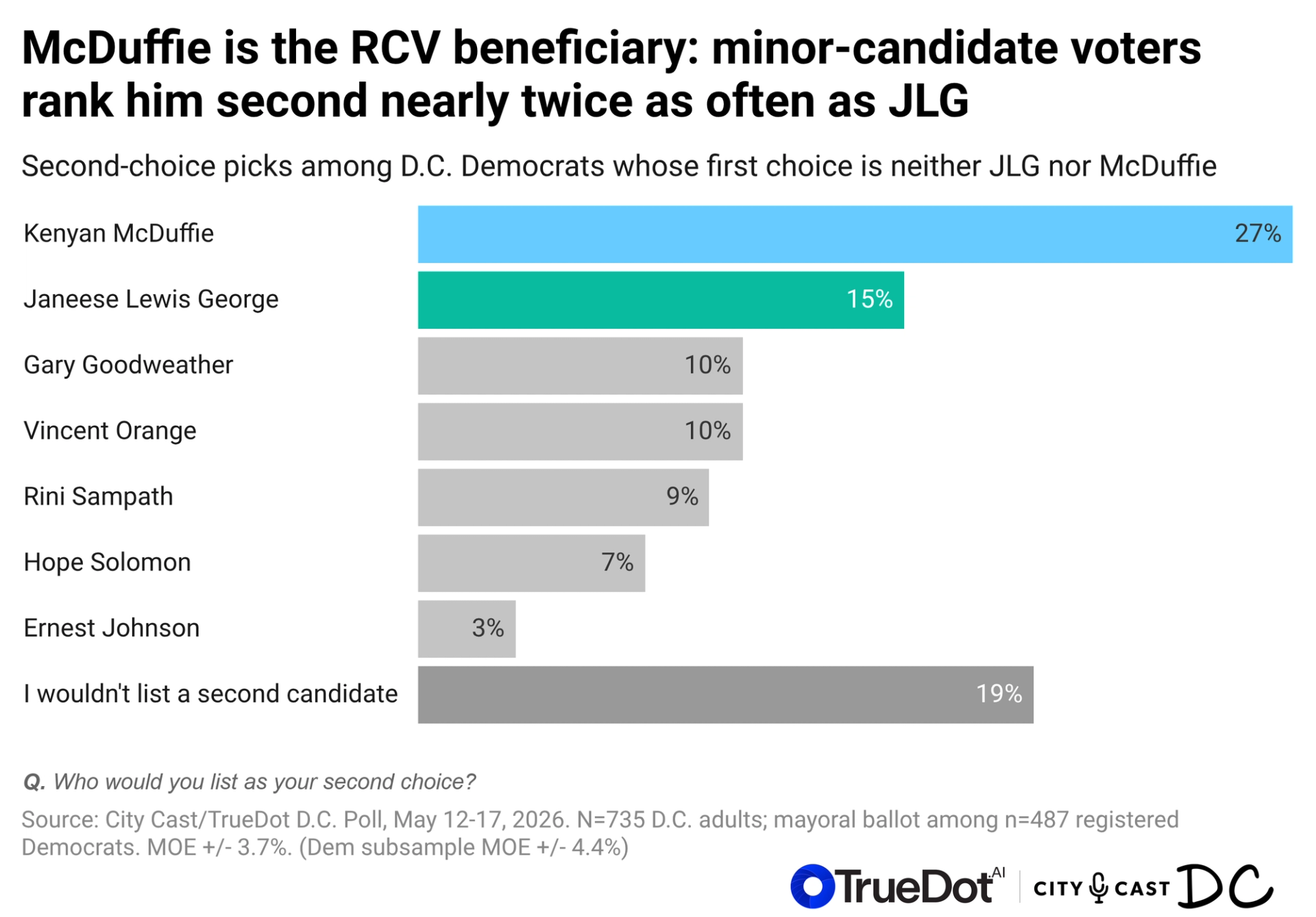
McDuffie, though, has a meaningful lead over Lewis George when it comes to second-choice votes among supporters of other candidates. Twenty-seven percent of those voters back him, against 15 percent for Lewis George.
Under ranked-choice voting, voters’ second, third, fourth, and fifth choices get factored in if no candidate wins an outright majority, which appears likely according to City Cast’s poll, conducted by the polling firm TrueDot.
“The second-choice results suggest McDuffie has room to grow through ranked-choice transfers, creating a real challenge,” said Jon Cohen, the CEO of TrueDot and a former polling director at The Washington Post. “But ranked-choice outcomes are inherently harder to model than first-past-the-post elections … So these numbers are best read as evidence of McDuffie's path to tighten the race under RCV, rather than an indication of the ultimate outcome.” (Some 30 percent also said they wouldn’t cast a second choice.)
With less than a month left in the race, the poll gives both leading campaigns reason for optimism. Lewis George has a lead, and the survey of voter sentiments suggests there’s a lot of passion around priorities like expanding the safety net, which polls higher than any other issue. Lewis George declined to comment on the poll results.
McDuffie would no doubt prefer to have a lead. But ranked-choice voting — ironically, something he opposed as a D.C. councilmember — gives him a real chance, as does the fact that nearly one in four voters remains undecided. The poll shows that his main rival is also on the wrong side of public opinion on curfews, which are driving headlines as the campaign heads into its final stretch.
“In the coming weeks, the 25% of voters who remain undecided will continue to learn about his record of delivering,” McDuffie’s campaign said in a statement. “Meanwhile, with three-quarters of voters saying that crime and safety are major concerns, Councilmember Janeese Lewis George…is going to have trouble.”
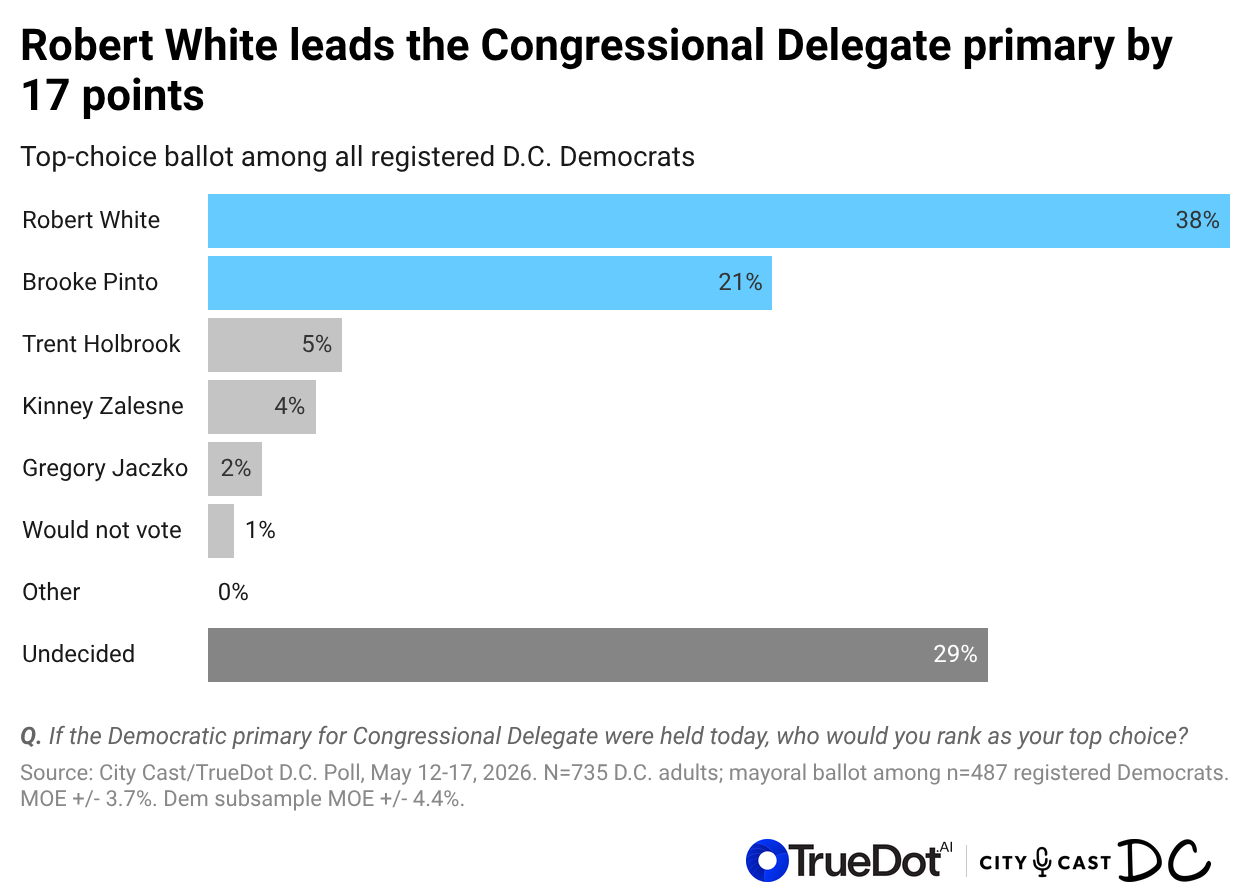
The outlook is a lot clearer in the race for D.C.’s non-voting Congressional delegate, where D.C. Councilmember Robert White holds a 38-21 lead over colleague Brooke Pinto. No other candidate tops 5 percent.
The survey, conducted between May 12 and 17, asked 735 District residents — including 487 registered Democrats — about the upcoming citywide races for mayor and Congressional delegate, as well as about an array of issues facing the District. The poll employed a hybrid sampling design and had a margin of error of 3.7 percent for the full sample and 4.7 percent for the registered Democratic sample.
Not Your Old D.C.
With little public polling so far in D.C.’s first open mayoral race in 20 years — and its first competitive Congressional race since 1990 — the survey offers a fascinating glimpse into a city whose political coalitions and policy priorities are in flux.
Among other things, the 2026 race seems to be scrambling the old assumption that race and geography are D.C.’s major political dividing lines. Historically, white voters and residents of the western side of the District have often gone in very different directions from Black voters and those who live in the eastern half of town.
Maybe not this time. While McDuffie’s support is generally stronger with black voters and Lewis George leads among white Washingtonians, both have racially diverse bases. Geographically, McDuffie leads in wealthy Wards 2 and 3, on the western edge of the city, as well as in historically poorer Wards 7 and 8, located at the District’s eastern tip. Lewis George, meanwhile, is well ahead in the central band of Washington.
Still, the divide by race is much less pronounced than the generational split. Where McDuffie leads by 27 points among baby boomers and older, Lewis George is preferred by 24 points among Gen Z members and 19 points among millennials. By contrast, Lewis George is up by six points among white voters and McDuffie by nine points among Black voters. (Voters who don’t identify as either prefer Lewis George by 39 points).
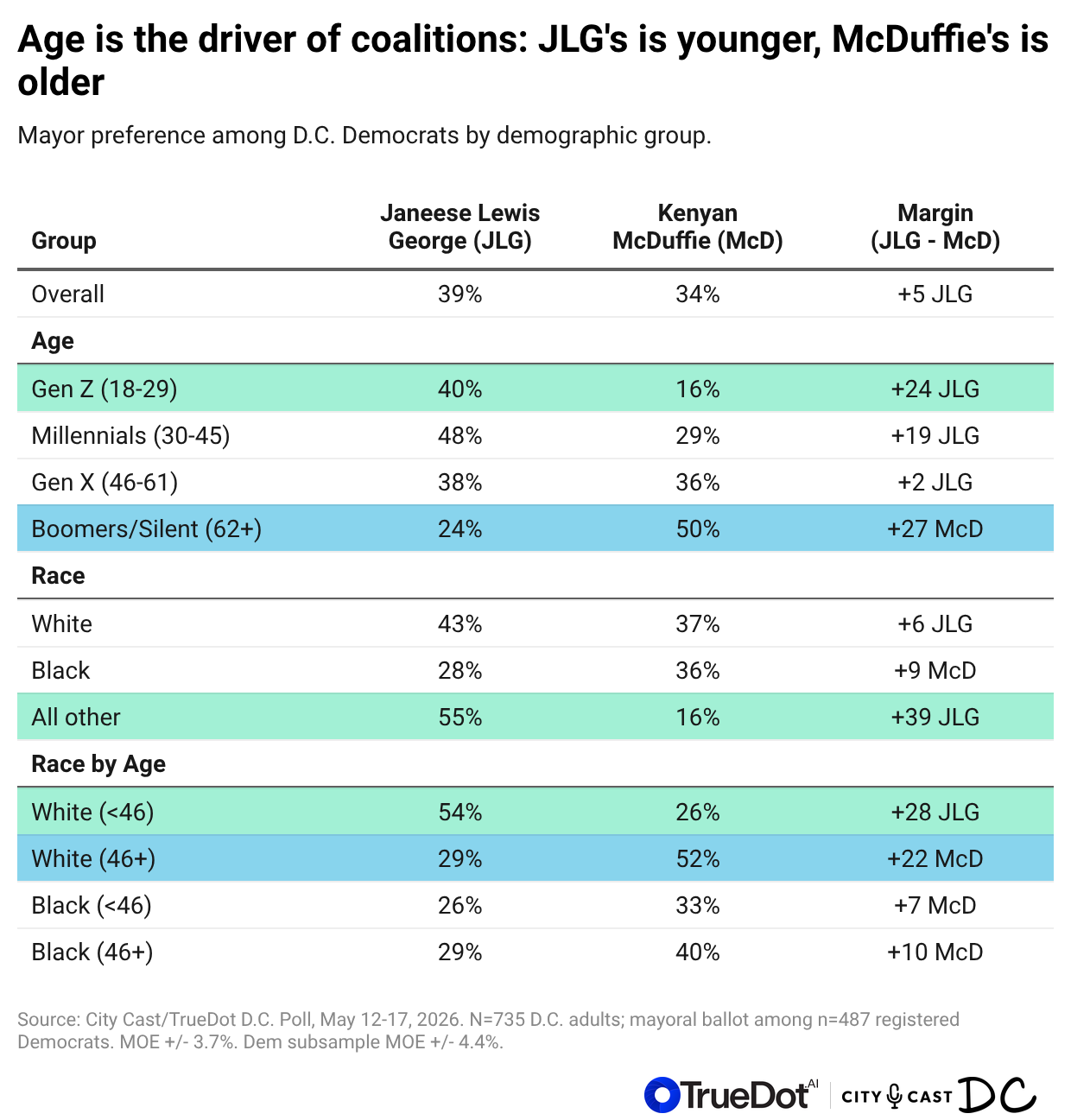
Age is a particularly striking divide among white voters. Those under 46 support Lewis George by 54 percent to 26 percent; those above 46 prefer McDuffie by 52 percent to 30 percent. In Black Washington, by contrast, McDuffie holds a narrow 6-point edge among voters under 46 and a 10-point lead among those over 46.
There’s also a dramatic gender gap, with Lewis George leading by 15 points among women while McDuffie leads by 4 points among men.
And when it comes to class, the Democratic Socialists of America member Lewis George does not seem to be cleaning up among D.C.’s poorer and less-educated voters. She’s leading by 13 points among voters with college degrees, while McDuffie is out front by eight points among those without.
Sign up for City Cast DC's daily newsletter
Lewis George also leads by nine points among voters with household incomes above $150,000 and ten points among those with household incomes between $75,000 and $150,000. McDuffie, meanwhile, holds a narrow five-point lead among voters with household incomes below $75,000.
Newbies Versus Natives
The bottom line: The younger, better educated, and newer you are to D.C., the more likely you are to support Lewis George.
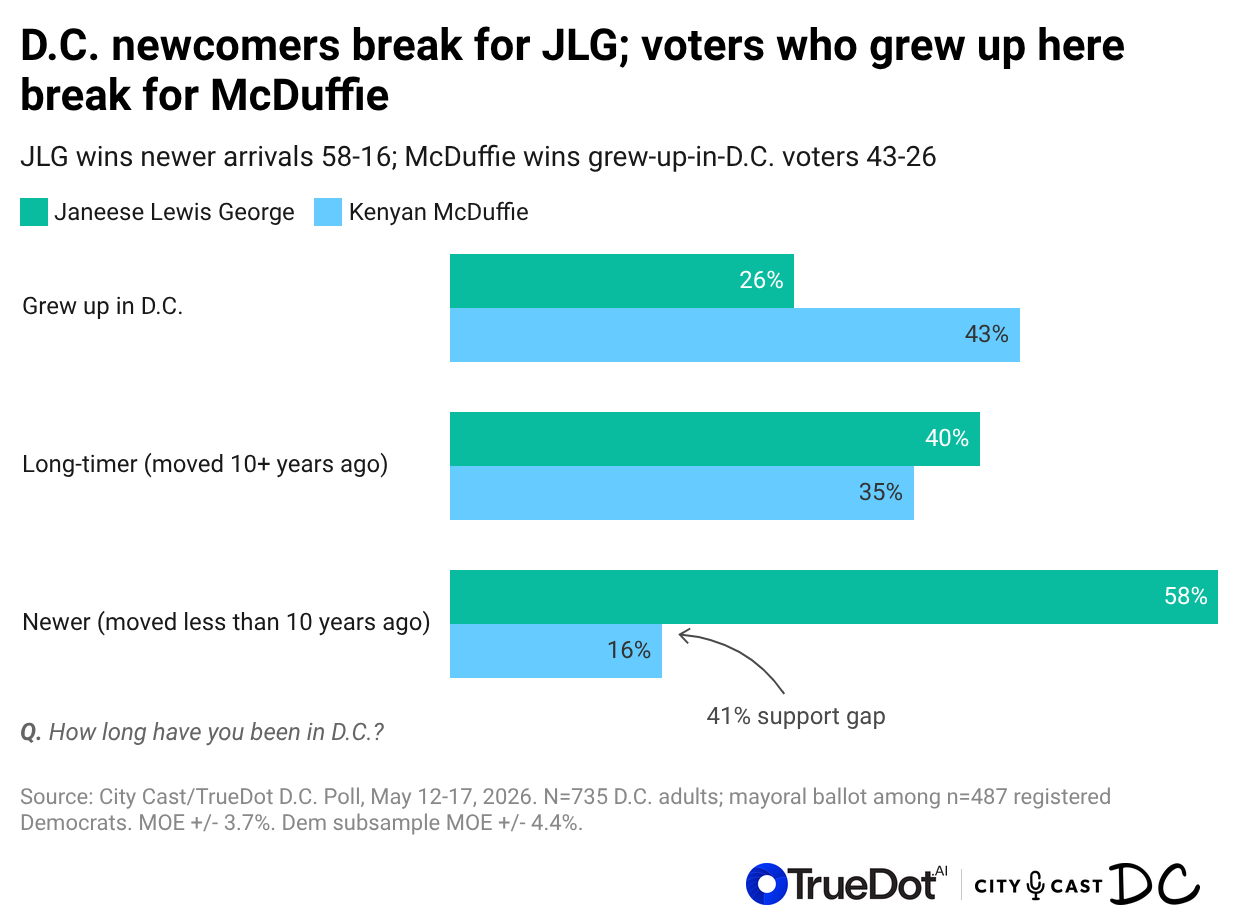
In a city where gentrification and demographic change has been one of the most emotional issues of the past few decades, the biggest divide may actually be time living in D.C. Voters who said they’d grown up in the District prefer McDuffie by 43 percent to 26 percent, according to the poll.
Among voters who moved to Washington within the past decade — 20 percent of the electorate — Lewis George crushes her rival by 58 percent to 16 percent, a whopping 42 points. She also holds a small lead among non-natives who’ve been here more than 10 years.
Age, class, gender, and tenure in D.C. also might help explain some of the more novel findings in the poll, which surveyed voters about lifestyle and tastes — superficial-seeming things that actually matter a lot in an era where culture drives a lot of voter behavior.
- Among self-described fans of football’s Washington Commanders, McDuffie leads by 19 points, 45 percent to 26 percent when people leaning to a candidate are factored in.
- Among self-described fans of baseball’s Washington Nationals, the candidates are closely divided, with 38 percent supporting McDuffie to 33 percent for Lewis George when people leaning to a candidate are factored in.
- Washington Post subscribers and local TV news watchers also give McDuffie narrow leads, but those who have gotten news from Instagram or TikTok favor Lewis George by 17 points, 42 percent to 25 percent when people leaning to a candidate are factored in.
- People who said they had commuted to work by bicycle within the past six months strongly favored Lewis George, 46 percent to 25 percent when people leaning to a candidate are factored in.
- People who said they’d eaten in a restaurant over the past six months where the bill came to more than $100 per person — a possible indicator of disposable income and cosmopolitan lifestyle — were essentially split.
- The poll also reveals a population sharply divided in its opinion of outgoing Mayor Muriel Bowser. Those who approve of her performance favor McDuffie, those who disapprove favor Lewis George. Notably, there’s also a massive age divide in views of the current mayor: Sixty-six percent of baby boomers and older rate Bowser positively; only 37 percent of Gen Z Washingtonians do.
On the Issues
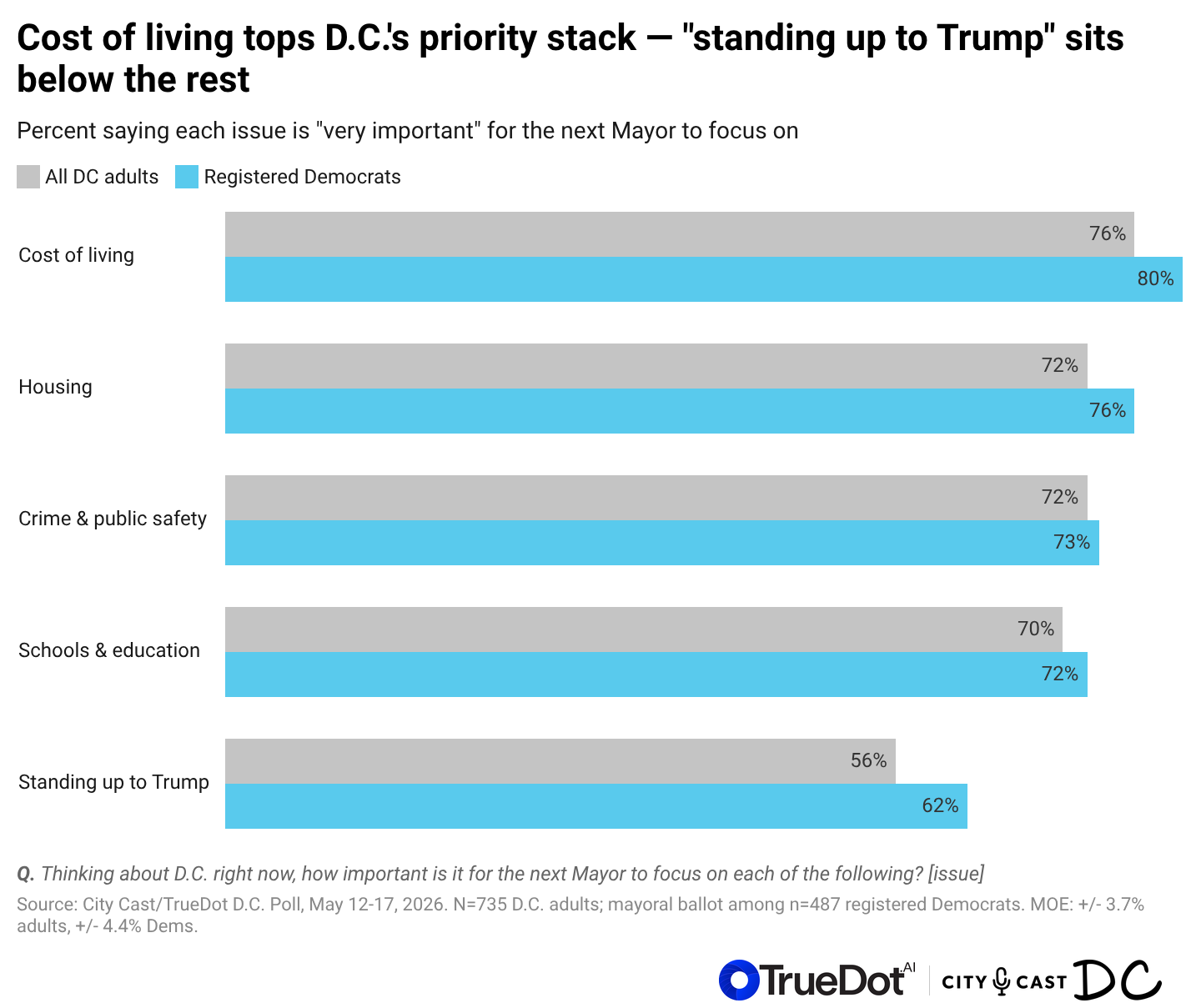
City Cast’s poll also surveyed residents on several key political issues, some of which have divided the mayoral candidates. Notably, the poll found that over 70 percent of voters rank issues like cost of living (77%), housing (71%) and public safety (73%) as very important for the next mayor, while only 57 percent felt the same way about standing up to Donald Trump.
On public safety, the poll found broad support for youth curfews that McDuffie has supported and Lewis George has opposed. 72 percent of voters say they favor the curfews; among those voters, McDuffie leads by 12 points. Notably, though, almost half of Lewis George’s supporters support curfews.
Likewise, McDuffie holds a strong lead among the 42 percent plurality of voters who want D.C. to hire more police, while Lewis George is the favorite of a 12 percent minority who would like fewer officers. Both candidates have called for more police. (37 percent of residents said they think the current size of the force is about right.)
On the other hand, Lewis George hasn’t ruled out raising taxes to pay for needed social services — and 78 percent of respondents seem to agree with that, answering that they’d favor expanding the safety net even if it means raising some taxes. Among voters who strongly support that idea, Lewis George leads by 50 percent to 26 percent when “leaners” are factored in. Among the smaller cohort who oppose raising taxes to pay for more social services, McDuffie has a similar lead.
Yet recruiting new businesses — even if it means giving tax breaks — also appears to have broad support, with 68 percent in favor and 25 percent opposed. On this issue, McDuffie is the one who’s way ahead among people who strongly support the idea, while Lewis George leads among those who oppose it.
The poll also found strong voter support for changing D.C. rules to make it easier to build more apartment buildings and townhouses in neighborhoods, something both candidates have voiced support for. But Lewis George holds a ten percent lead among those who strongly support the idea, while McDuffie has an 11 percent lead among the much smaller number of voters who oppose it.
It’s one of several issues involving changes to the contours of public life in D.C. where broad majorities favor the change — but where those who oppose it tend to support McDuffie. He also leads among those who want to roll back bike lanes and those who are hostile to streateries, both of which are rather popular, according to the poll. (McDuffie himself has not opposed either idea.)
But McDuffie’s not the favorite of the change-averse on every issue. Lewis George supporters are much more skeptical than McDuffie supporters about self-driving taxis, which McDuffie has pushed to allow on D.C. streets.
Congressional Race
In the race for Congress, White is being elevated by essentially the same coalition that has most strongly embraced Lewis George: Younger, better educated, progressives. But he also leads among Black voters and older voters, where she struggles. Notably, he has the same level of support — 35% — among people who grew up in D.C. as he has among people who’ve moved to town during the past ten years. Still, nearly three in ten voters say they’re undecided, which adds some unpredictability to the race.
That didn’t stop White from exulting. “It shows that D.C. voters are sending a clear message: they want a leader who will fight for working-class Washingtonians and who understands and lives the values of this city,” he said yesterday. “People are worried about their jobs, worried about their safety, and tired of feeling like they are carrying the burden while those with power and privilege look the other way. They know this campaign is different because they know they have a voice in this movement and a fighter who will never stop standing up for them.”
Pinto enthusiasts, meanwhile, took solace in the large number of undecideds, the possibilities of ranked-choice voting, and the fact that White’s number in the City Cast poll is still lower than the 40 percent he got in the 2022 Democratic mayoral primary against Bowser.
"This is a wide open race, and it's clear the momentum is behind Brooke Pinto,” campaign manager Drew Godinich said. “We have built the infrastructure to win - but more importantly, Brooke Pinto has a vision of a DC with our own autonomy, with safer neighborhoods, and an innovation-based economy that has affordable housing opportunities for everyone. Brooke Pinto has been outhustling the competition, and we're not stopping until we win."
Methodology: The May 2026 CityCast DC Poll was conducted by TrueDot among a total of 735 adults residing in the District of Columbia. Interviews were conducted May 12-17, 2026. Among the full sample of D.C. adults, 487 registered Democrats were asked questions about the upcoming Democratic mayoral primary. No respondent data was inferred or modeled.
The survey employed a hybrid sampling design. A total of 384 interviews were conducted with registered voters sampled from the D.C. voter file and reached via text message. An additional 351 interviews were completed with D.C. adult residents recruited through online panels. To ensure the total sample reflects the adult population of D.C., post-stratification weights were applied along key demographic dimensions, including D.C. ward, age, race/ethnicity, educational attainment, gender, and results from the 2024 general elections.
The modeled error estimate for the full sample is +/- 3.7 percentage points at the 95% confidence level. The modeled error estimate accounts for the complexity of the sampling design, including weighting and the use of non-probability panel sources, and should be interpreted as an approximation of total survey error rather than a traditional margin of sampling error. Subgroup estimates carry larger modeled errors.