Between DOGE devastation, the police takeover, and a severe regional slump, D.C. has had a famously rough time over the past couple years. And those numbers showed up in City Cast’s poll of Washingtonians ahead of the mayoral race — which is full of questions about life and lifestyle that go beyond the candidates who happen to be running for office.
Eleven percent of Washingtonians, including 15 percent of Black residents, said they or someone in their household had lost a job as a result of the Donald Trump administration’s federal cutbacks. A further 34 percent said a close friend or family member had been hit.
Nearly half of residents — including significant majorities of Black D.C.ers — said they are worried about their family being able to pay for housing, utilities, and food.
Residents were also meh on the incumbent mayor, Muriel Bowser, with 49 percent calling her performance excellent or good and 48 percent rating it mediocre or bad.
And they were downright appalled by the President: 86 percent disapprove, 75 percent strongly. In D.C., that’s not just a national political question, given Trump’s ambitions to remake Washington. Some 79 percent of locals are negative about plans like the luxury Hains Point golf course, the triumphal arch, or a new blue paint scheme for the reflecting pool. They also oppose the National Guard deployment by 60 to 36 percent, with just over a quarter of Washingtonians saying that “it feels like an occupation.”
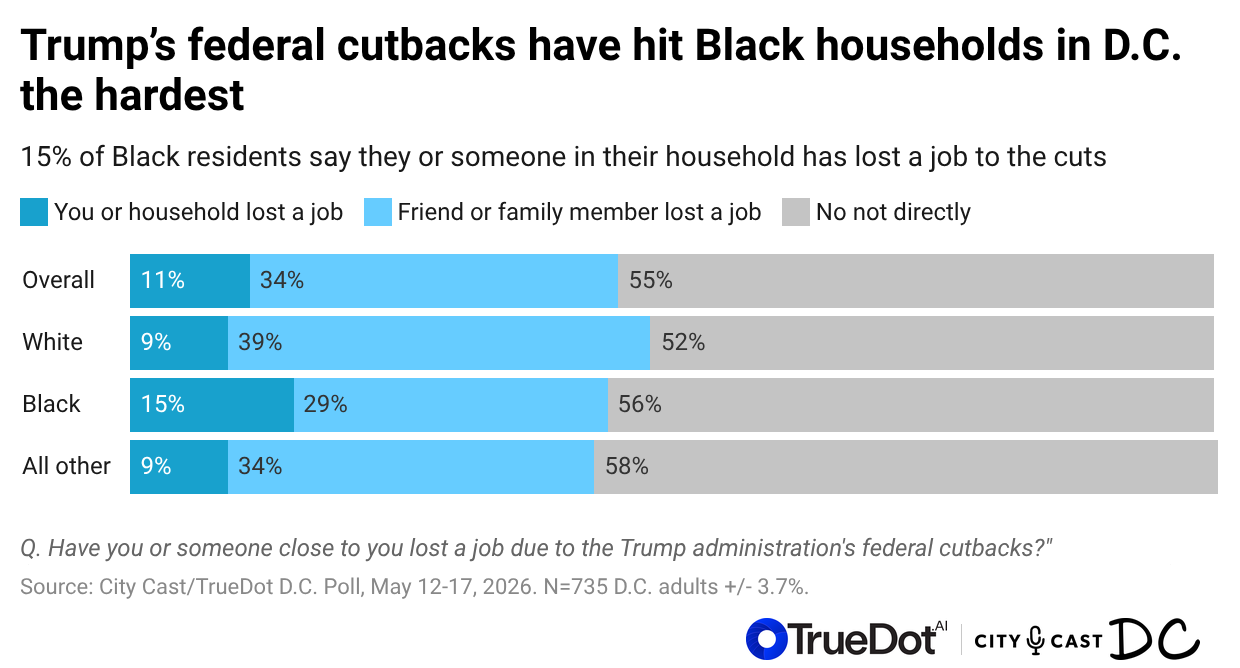
The survey, conducted by the polling firm TrueDot between May 12 and 17, asked 735 District residents about the upcoming city elections as well as their general sense of the city. The poll employed a hybrid sampling design and had a margin of error of 3.7 percent for the full sample.
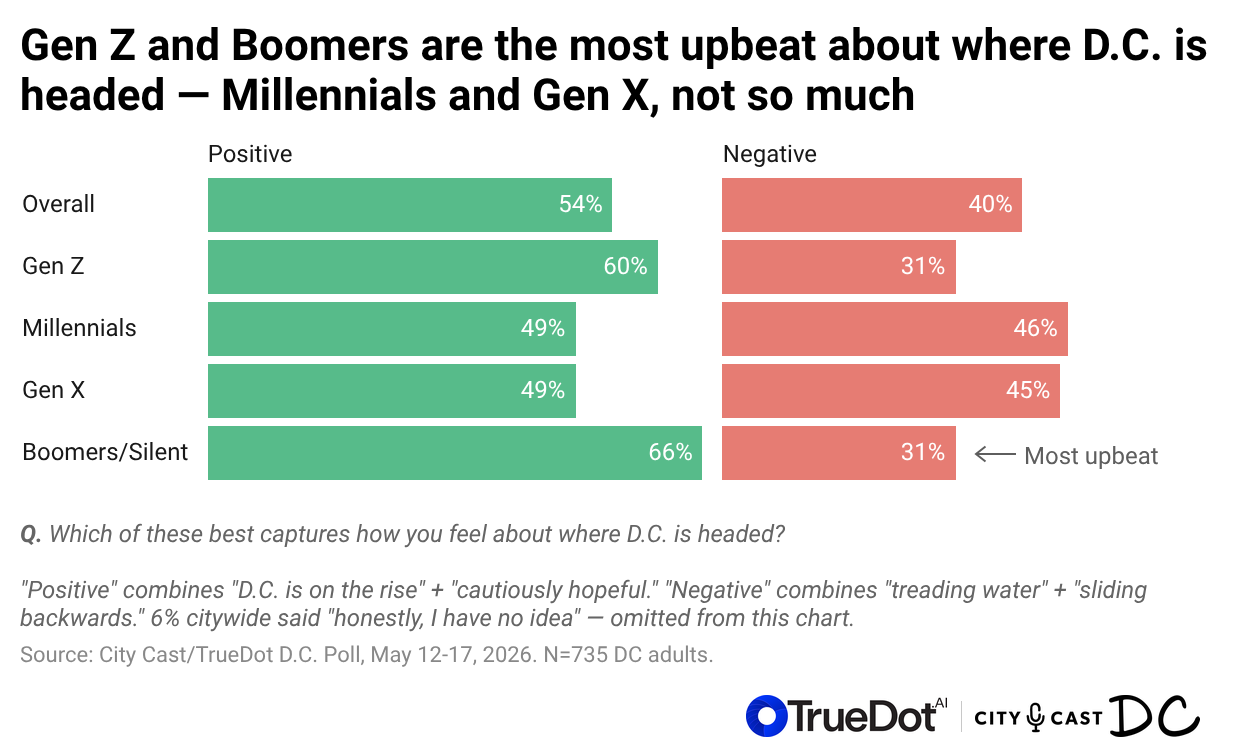
The most surprising finding in the poll, though, is one that cuts in the exact opposite direction: Some 54 percent of respondents said they were hopeful about the city’s future, against 40 percent who aren’t. That’s not runaway happiness, but after the year we’ve had, it’s quite remarkable.
And, beyond that, the vibes are fairly consistent across the District’s various political and demographic divides: White (51%) and Black (56%); rich (54%) and poor (55%); supporters of Kenyan McDuffie (61%) and Janeese Lewis George (54%); Washington Post subscribers (55%) and folks who get their news from Instagram and TikTok (57%); people who’ve lost federal jobs (51%) and people who haven’t (55%).
There are, of course, a couple of categories that break the mold. Members of Gen Z (60%) and the Baby Boom generation or older (66%) are happier than Millennials or Gen X (both 49%). And negative feelings lead narrowly among white people with a household income more than $150,000. But even Commanders fans (64%) and Nationals fans (60%) were positive — and neither has had much to cheer about.
So are we just a city of Polyannas? In theory, of course, that positivity could reflect a view that once you’re at rock bottom, there’s nowhere to go but up.
Yet the details of the poll also showed a city with a lot of engaged citizens — and generally favorable feelings about an array of changes to local life.
Take housing, one of the most contentious issues in city politics. As housing costs have become a concern, city policy has moved — haltingly — towards a new idea: That Washington needs to build more apartments and rowhouses, even if it means upsetting some residents’ assumptions about living in leafy neighborhoods with ample parking. Each step in this direction has tended to be met with howls from people on the other side, who feel that their D.C. is being taken away.
But in our poll, it turns out that 68 percent of Washingtonians support this change, effectively welcoming the creation of a very different-looking city.
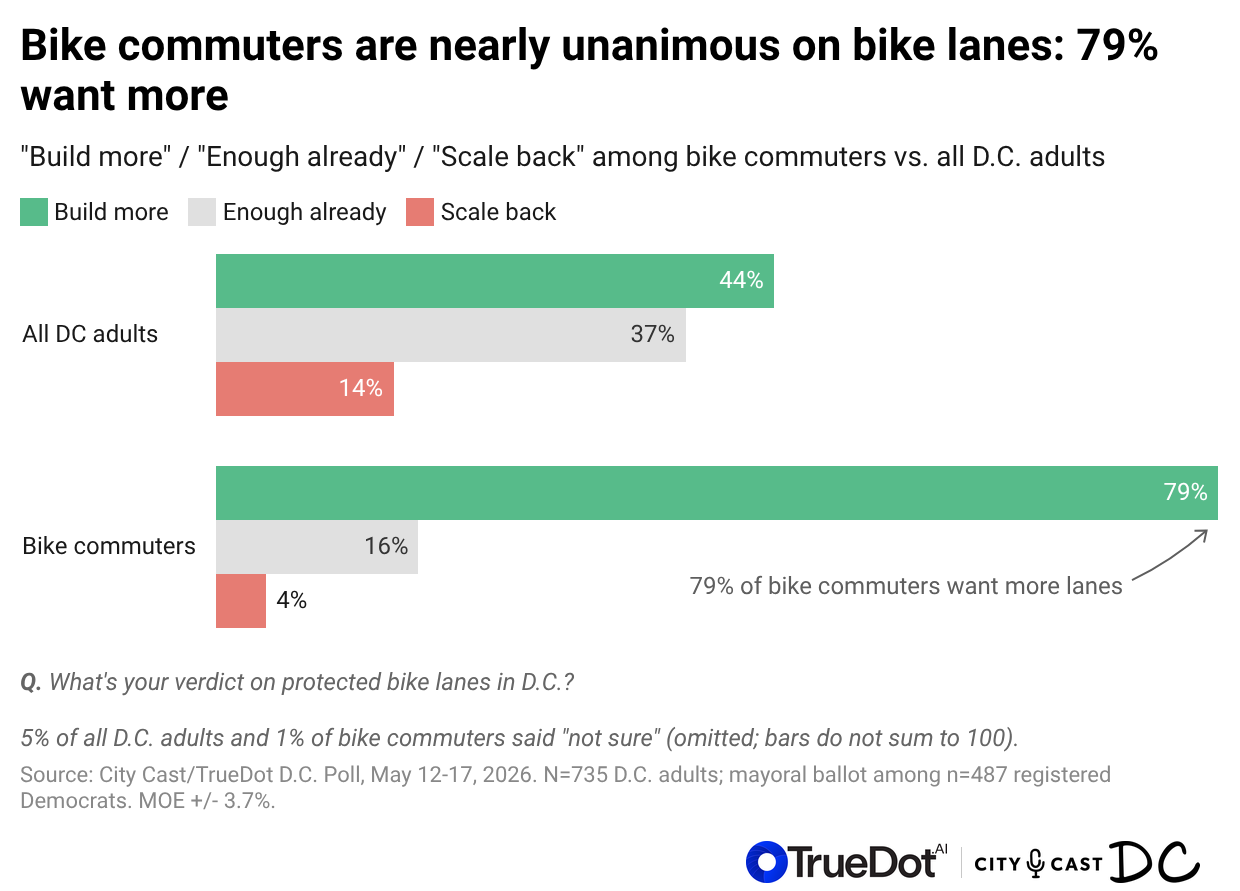
Same goes for smaller changes that might be seen as distinguishing the emerging D.C. from the historic one. Only 14 percent of residents said they want to get rid of bike lanes, a perennial point of tension. They also favor, by 61 percent to 33 percent, allowing streateries to continue.
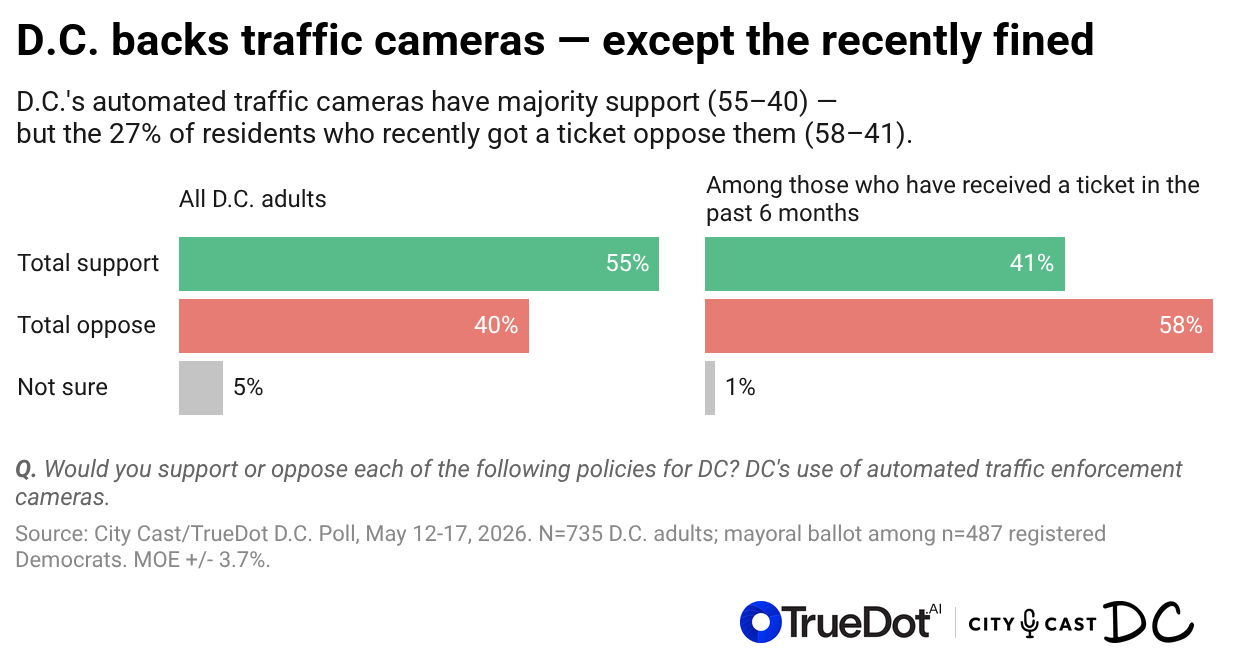
About the only one of the daily annoyances of city life where there’s a real split is D.C.’s automated traffic enforcement cameras, which 55 percent support and 40 percent oppose. That opposition is much more pronounced among Black Washingtonians.
Though residents are closely divided over who they’ll vote for in the mayor’s race — Lewis George leads McDuffie by 5 points — there’s actually a lot less division over major policy questions.
Some 78 percent of residents say they favor boosting the safety net even if it means more taxes, a position most associated with Lewis George, a Democratic Socialist. But 72 percent favor youth curfews, the headline-dominating issue that McDuffie has championed and Lewis George opposes.
The generation gap that appears to have become the key demographic fault line in the mayor’s race also shows up in some of the data on happiness and policy. Younger voters and those newer to D.C. are much more likely to support bike lanes, streateries, and density. And while every age group is opposed to Trump’s plans for the National Mall, members of Generation Z only oppose them by 60 percent, where nine out of ten Baby Boomers are against them.
Just like in the mayor’s race, there wasn’t a massive difference between Black and white respondents on the big question about optimism. But there was a fairly jarring one when it came to one measure of belonging and security. Asked if they think they’ll still be in D.C. in five years, seventy percent of white Washingtonians said yes, while only 49 percent of Black Washingtonians did.
The survey also polled residents about various lifestyle questions, which have a way of bleeding into views about politics and feelings about the direction of the city. Among other things it found that:
- 46 percent of Washingtonians had been to a restaurant in the past six months that cost more than $100 a person
- 44 percent had visited a Smithsonian museum during that time
- 33 percent had used a shared bike or scooter
- 30 percent had gone to a religious service when it wasn’t a holiday
- 28 percent had submitted a 311 request
- 27 percent had gotten an automated traffic ticket
- 20 percent had been to a protest
On these questions, though, race was a significant divide — even more than income or age. White people were almost twice as likely to have gone to an expensive restaurant, almost three times as likely to have been to the Smithsonian, and seven times more likely to have been to a protest. About the only measure where the experiences of white and Black D.C. were similar is in church attendance.
So, after all that, it’s clear that some of the old Washington divisions remain very evident. But at least most of us say we’re happy.