

D.C. may not know the winner of the mayoral race for up to 10 days after the primary election, setting residents up for at least a week of uncertainty as they await results.
The District’s first foray into ranked-choice voting, paired with its policy of sending mail-in ballots to all registered voters, has the city preparing for delays. Election officials expect the first ranked-choice voting tabulation in the June 16 primary to be released by June 21, but D.C. law requires that mail-in ballots postmarked by Election Day continue to be counted until June 26.
“If we have to wait, we’re just going to wait and that’s how it goes with ranked choice voting,” said Gary Thompson, chair of the D.C. Board of Elections. “We’ll get to a reliable result as efficiently and quickly as possible without compromising on accuracy.”
But could this open the door to attacks from critics in Congress and the White House? The question is on people’s minds as the long delay in counting ballots from last week’s California elections has led to conspiracy theories about fraud, amplified by President Donald Trump and other top conservatives.
“Here we go with very late and massive numbers of MAIL IN BALLOTS,” Trump said in a Truth Social post last week. That’s not a good sign for the District, which accepts ballots for even longer than California and where two-thirds of people voted by mail in the last mayoral primary. (Plus, everything from crime statistics manipulation to a viral Chipotle brawl has become fodder for Republicans to question whether the District can rule itself).
In D.C., a Republican congressman and the editor-in-chief of The Daily Caller have posted about receiving other people’s ballots in the mail, pointing to it as a sign of potential fraud. (I also received two mail-in ballots addressed to other people, presumably the former tenants of my apartment.)
Voter fraud is rare nationwide, but research shows Americans increasingly mistrust elections. To combat these fears, the D.C. Board of Elections hosted 87 voter education events in May, according to its public calendar. They took place at libraries, churches, community centers, food pantries, universities and even Nationals baseball games in an effort to prepare voters for a new kind of election – one in which it will take both longer to fill out a ballot and to learn the results.
“It’s important to build trust and confidence in the system to make sure people understand how this works,” Thompson said.
Here’s what else you need to know about ranked-choice voting, how the District prevents voter fraud and when D.C. will know its next mayor.
When will we know who won?
Any time between June 16 and June 26. After polls close at 8 p.m., Thompson said the board will report the number of first-choice ballots each candidate received from in-person votes that day and during the early voting period, as well as any mail-in ballots that have already been counted.
A winner is declared once any candidate gets more than 50 percent of votes. We could know the winner of some races on election night but polling shows that almost certainly won’t happen in the mayoral race.
In the days following the election, the board will wait until they have counted the majority of ballots to begin ranked-choice voting tabulation. Thompson said they will publish interim tabulations as they go, with the first expected to be released by June 21.
"It just comes down to patience,” Thompson said. "We obviously have to respect the fact that hundreds if not thousands of voters will be putting their ballots in the mail on or shortly before election day.”
Why could it take so long?
D.C. has for years accepted postmarked ballots that arrive up to 10 days after polls close but, under the new ranked-choice voting system, this policy will contribute to longer counting times.
Now, a voter can rank up to five candidates per contest. If any candidate gets more than 50 percent of first rankings, they win. But if no one reaches a majority, the lowest performing candidate in the race is eliminated. If that’s who you happened to rank first, your vote will be reapportioned to your second choice pick. And so on, until one candidate clears the 50 percent threshold.
“Think of it like the show Survivor – somebody gets eliminated,” Thompson said. “At some point you might be tapping into voters' third choices, fourth choices, even fifth choices – you just keep doing that until someone crosses the 50-yard line.”
Because candidates are eliminated based on who receives the least first choice votes, those eliminations can’t happen until Thompson and his board colleagues have received enough ballots to feel confident which candidate is in last place, which is where the 10-day mail-in policy complicates things.
What do the leading mayoral candidates have to say about ranked-choice voting? And do they have a plan if the results are contested?
The Kenyan McDuffie and Janeese Lewis George campaigns both expressed confidence in D.C. election results in statements to City Cast DC.
Despite expected delays, a campaign spokesperson said Lewis George remains hopeful election night shows a “decisive result” and urged residents to vote early.
“A lot is dependent on how many residents vote early,” said Amanda Michelle Gomez, communications director for Lewis George. “The more people who vote early, in person at early vote centers or by mail at mail ballot drop boxes, the sooner we learn the results of the elections.”
When asked if Lewis George had a plan to address potential attacks, here’s what she said: “Any efforts to interfere with the results of the elections, overturn DC’s laws, or undermine local autonomy are unacceptable. Our campaign is prepared to defend the results of the election.”
McDuffie said he understood why residents could be frustrated with the delay or impatient for results, but said his first priority is that “every ballot is counted and every voter’s voice is respected.”
“As mayor, I will continue to ensure that our election system protects the integrity of every vote and work to deliver results in a timely manner that the public can trust,” he said.
Despite the anticipated delays, both candidates are still planning to host parties on election night – McDuffie at The Park at 14th, Lewis George at The Howard Theatre, where she first announced her campaign.
Why did I receive a ballot that’s not mine and what should I do with it?
If you, like me, received strangers’ ballots, here’s what to do. First and foremost, don’t fill out a ballot that’s not yours – that’s a crime. Instead, mark the ballots “return to sender” and put them back in the mailbox or drop them in one of the 55 ballot drop boxes across the city.
“You gotta just look at it and say ‘Well, that’s not for me’ and not fill it out,” Thompson told me.
D.C. law requires mail-in ballots to be sent to all registered voters, but voter rolls are not always up to date. Thompson said the board ends up with thousands of returned ballots each election, most commonly because people move and forget to update their address in their voter registration.
How does D.C. prevent voter fraud?
Just like in-person voting, a mail-in ballot requires a signature that will be checked against the one on file in the voter registry, Thompson said. If the signatures don’t match, the board will investigate. Plus, databases like the Electronic Registration Information Center help flag if people have voted in multiple jurisdictions or in the name of someone who has died.
“Hardly anybody does this,” Thompson said. When asked how many instances of voter fraud the board flagged last D.C. mayoral election, he said he could “count them on one hand – maybe two.”
The board addresses each case on an individual basis, Thompson said. If it seems someone filled out the wrong ballot by accident, they’ll receive a $100 fine. But if the board suspects it could have been purposeful, Thompson said the incident will be referred to the D.C. Attorney General’s Office for prosecution.
What ranked-choice voting mistakes should I avoid?
It’s pretty straightforward, Thompson said: don’t give any two candidates in the same contest the same ranking and don’t skip a ranking. If you chose to only rank one or two candidates instead of five, that’s fine – just don’t rank someone first and your next option third.
If you do make a mistake, under ranked-choice voting it’s possible your ballot could be counted anyway. If you accidentally rank two candidates second, your first choice vote will still be counted as long as that candidate isn’t eliminated. And even then, your ballot will only be invalidated for that race, not the entire election.
Am I eligible to vote?
D.C.'s closed primary system means many of the races are only open to voters registered with a party, though all registered voters can vote in the at-large special election. The District is so deeply blue that it is widely understood that the winner of the democratic primary will win the general election in November. The deadline to register with one of the parties or change party affiliation has already passed.
Notably, 17-year-olds can vote in the primary election as long as they will turn 18 by the general election on Nov. 3.
You can check your voter registration here.
How do I vote?
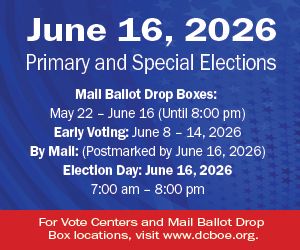
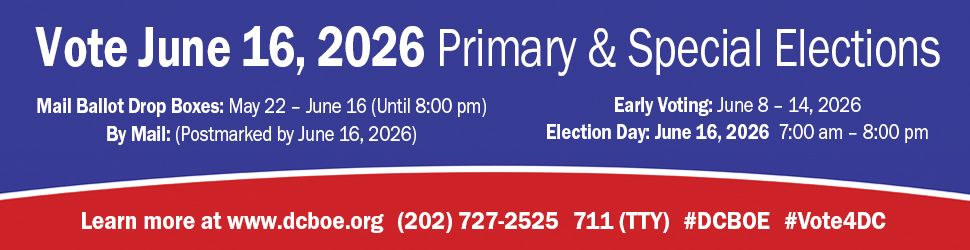
Election Day is June 16, and early voting began June 8.
You can vote in person at a voting center from 8:30 a.m. to 7 p.m. daily until June 14, or from 7 a.m. to 8 p.m. on June 16. Mail-in ballots can be mailed back, placed in ballot drop boxes or returned to voting centers. Here is where to find your nearest drop box or voting center.