

Kenyan McDuffie is finally showing his teeth. Aside from a viral moment last month when he walked off a debate stage in protest, the former council member has largely been seen as the race’s lower-energy, establishment-aligned mayoral candidate. But he’s now signaling a more aggressive path forward, vowing to “call out misinformation” and reclaim the narrative from his top opponent, Ward 4 Council member Janeese Lewis George.
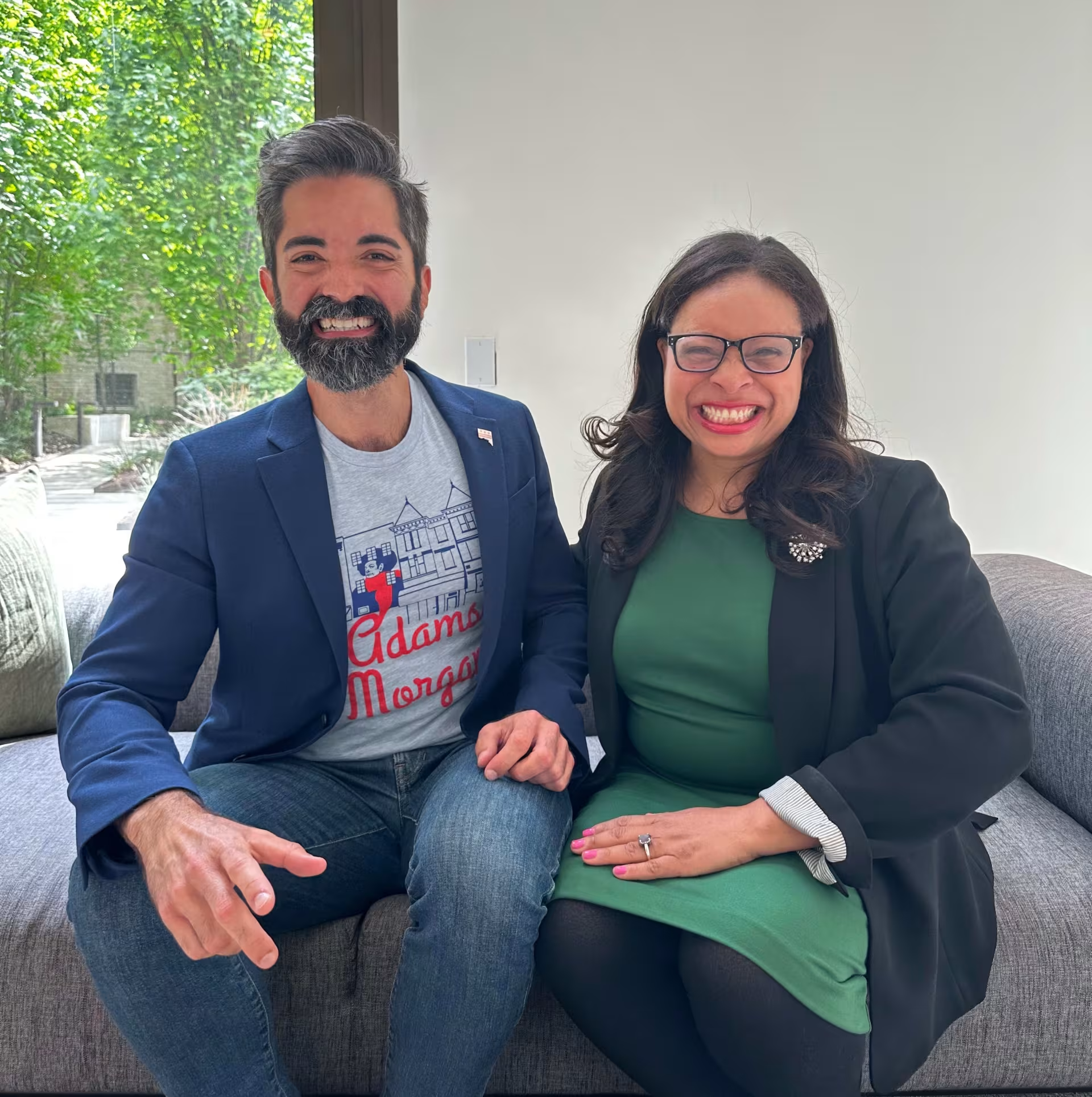
At Monday’s mayoral candidate forum, led by The 51st and other local news organizations, that new gear was on full display. McDuffie arrived at the forum with a vocal contingent of supporters in campaign sweatshirts — a visible attempt to display the movement energy that has been a staple of the Lewis George camp since her December launch.
He didn’t stop at the branding. During his closing remarks, McDuffie took a direct swipe at what he claimed was Lewis George’s imported political model, asserting he would not run a campaign based on “dark money coming out of New York City.” It was a pointed reference to Lewis George’s ties to the Metro DC Democratic Socialists of America, a local chapter of a national organization that has been a key part of her ground game.
Lewis George met the jab with a practiced cool, and her campaign later dismissed the accusation as a misunderstanding of her local coalition of labor unions and the Sierra Club. On stage, she flipped the script and questioned McDuffie’s own establishment fundraising by claiming she is “not taking big Trump donor dollars like other candidates.”
With a little less than two months until the June primary, the forum marked a shift in what has otherwise been a sleepy mayoral race. While Lewis George’s campaign is projecting confidence, the path to winning the primary now depends on which version of District leadership voters choose to buy.
The pragmatic native son
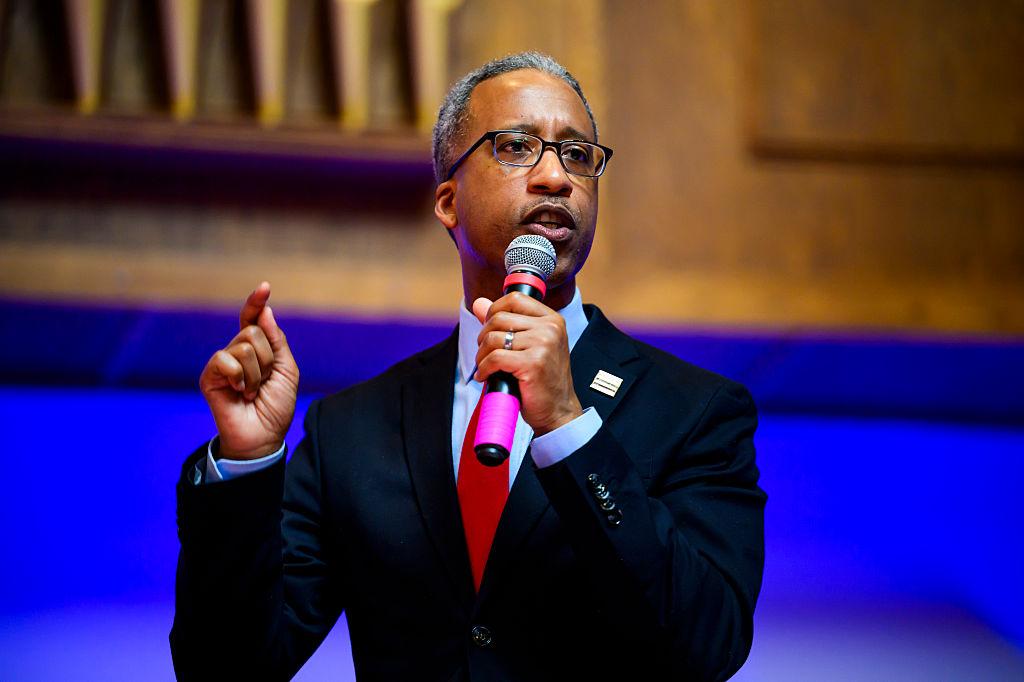
Kenyan McDuffie speaks during the Free DC candidate forum on March 14, 2026. (Photo by Pete Kiehart for The Washington Post via Getty Images)
McDuffie’s counter-narrative relies heavily on his roots as a fourth-generation Washingtonian. His campaign website features a prominent "from mailman to mayor" pitch — a biographical anchor he has leaned on for years to illustrate a blue-collar connection to the city. However, in a primary defined by a looming fiscal crisis and the vacuum left by Mayor Muriel E. Bowser’s exit, there's growing skepticism among political operatives that legacy branding still carries the weight it once did.
The questioning isn't about McDuffie’s local bonafides — Lewis George is a native Washingtonian as well — but about whether his brand of leadership is a sufficient answer to the city’s major structural challenges. To counter that skepticism, he is leaning on his legislative record and what his campaign calls a history of delivering “actual results.” And to address criticisms that he has been less publicly visible, the campaign has argued that his focus has simply been concentrated elsewhere: in living rooms and at people’s front doors rather than on social media.
It is an investment in traditional retail politics, but increasingly looks like a campaign trying to protect its ground. Despite McDuffie’s 14 years of business, legislative and legal experience, the “native son” identity has not prevented a mass migration of major labor endorsements to Lewis George’s camp. That has left McDuffie vulnerable to the portrayal of him as a well-connected insider, a narrative currently being amplified by a Sierra Club-funded “fact check” campaign that frames his legislative record as a series of missed opportunities for oversight in favor of corporate cozying.
For McDuffie, the forum was an attempt to prove he can still translate his institutional know-how into the kind of public passion required to win over a city in transition.
The bold progressive
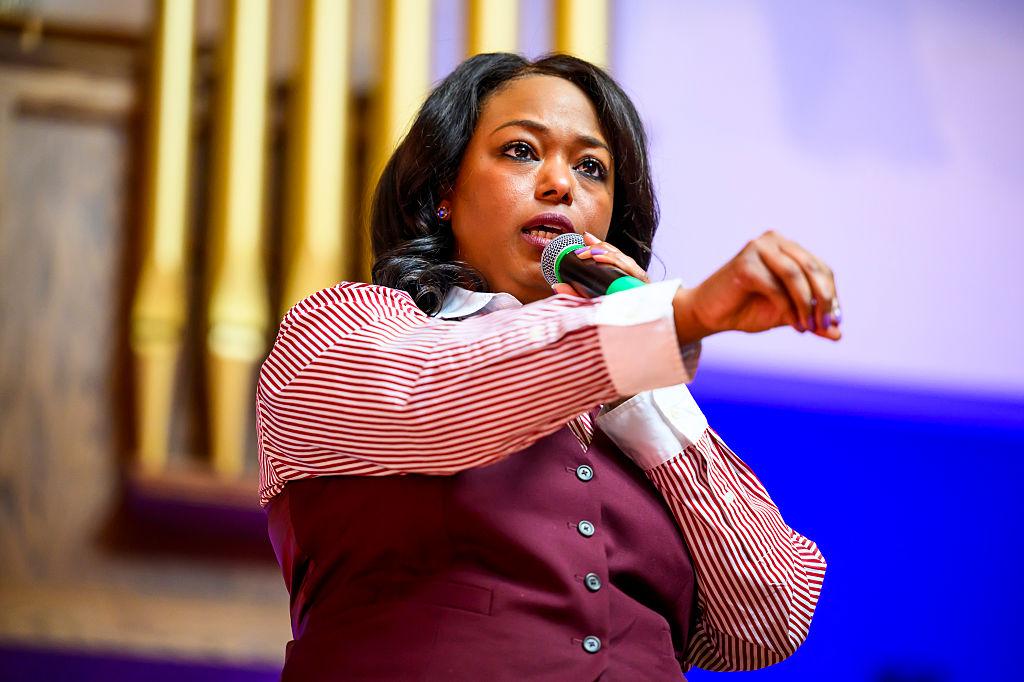
Janeese Lewis George speaks during the Free DC candidate forum on March 14, 2026. (Photo by Pete Kiehart for The Washington Post via Getty Images)
Lewis George, meanwhile, is operating on a different premise: that after a decade of the Bowser model, residents aren’t looking for a steady hand to manage a decline — they're looking for someone willing to challenge the system’s fundamental math.
The centerpiece of that challenge is a three-part budget framework intended to fund critical investments like childcare while stabilizing the District’s bottom line. It calls for a forensic review of the city’s $20 billion budget to find efficiencies and a more aggressive pursuit of federal funding to prevent local dollars from being returned to the treasury.
The final and most contentious pillar is her proposal to close business tax “loopholes” through a Business Activity Tax to potentially fund her universal childcare proposal. Lewis George estimates the shift to capture revenue from large corporations and lobbying firms with nonresident owners could raise $500 million to support local families. While organizations like the DC Fiscal Policy Institute have advocated for this tax as a tool for equity, McDuffie has argued it will make it harder for the city to both keep business and attract new ones. Fellow mayoral candidate Rini Sampath echoed that sentiment at Monday’s forum, arguing the District needs to “attract more businesses, not turn them away.”
The candidates are also divided on housing. Lewis George is championing a goal of 72,000 new units in five years — a figure she says is aggressive but necessary to “inspire real change.” McDuffie has countered with a more modest proposal to build 12,000 new housing units while preserving 20,000 affordable units by 2030, using the gap to pitch himself as the candidate who is “honest” about what the city can deliver without making “false promises.”
The race is also a clash of two very different campaign machines. Lewis George, leaning on the muscle of a broad coalition of labor unions, is betting that grassroots enthusiasm can overcome McDuffie’s name recognition. Her campaign has leaned heavily into portraying him as a corporate insider, calculating that her image as a mother juggling a toddler and the city’s budget will resonate more than his lengthy resume. McDuffie, however, positions that same resume as his primary weapon, framing his experience navigating the District’s machinery as the only thing that can actually turn the city’s gears.
Eight weeks to the primary
The home stretch is shaping up to be a referendum on these two distinct theories of power. McDuffie’s camp hopes his opponent’s movement will hit its ceiling early, while the Lewis George campaign is banking on the idea that their aggressive ground campaign and social presence has created a base that would run through a wall for her.
McDuffie’s closing case rests on the belief that, as the primary approaches, voters will choose a more familiar face to manage the District’s precarious financial reality. Lewis George offers the inverse: that the electorate is finally ready for a clean break from the current establishment.
The fight between these two camps is intensifying, but neither has yet proven it can break through the city’s broader sense of apathy — a gap that may ultimately decide the race.