

City Cast DC is conducting interviews with the front-running candidates in the D.C. primary election this year.
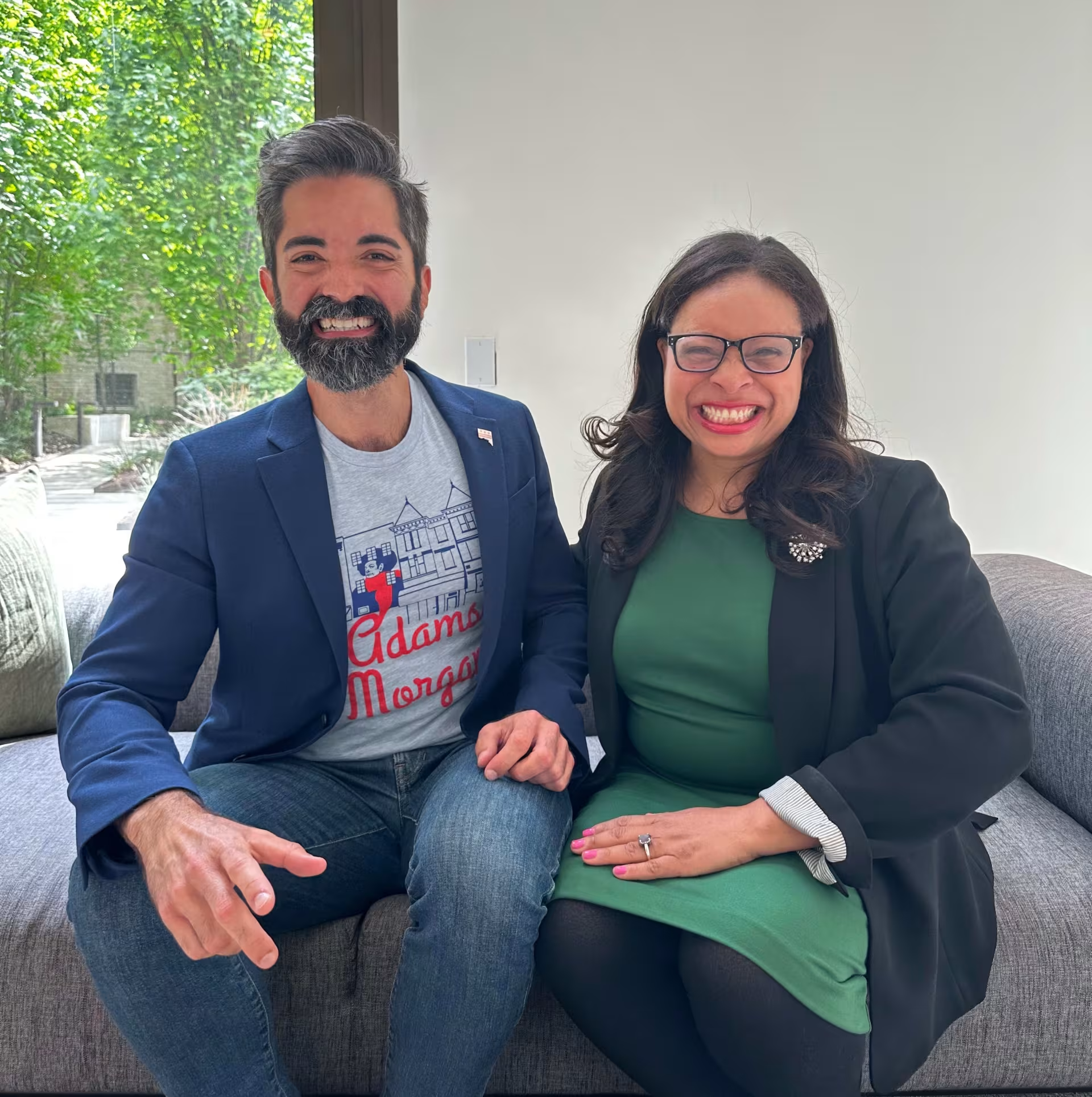
Here’s the transcript from the interview that executive editor and co-host Michael Schaffer did with D.C. Councilmember Janeese Lewis George, who is running for mayor. The interview has been lightly edited for clarity. You can also listen to the interview here.
Janeese Lewis George, thank you so much for coming in to talk.
Thank you for having me. I'm a fan.
So you're a D.C. native, as am I. And you know, you have talked movingly about growing up on Kennedy Street, going across the park to Alice Deal. Seeing how different and unequal D.C. was, I wanna just set the table. Do you think a child growing up on Kennedy Street today, like you, has a better chance of good outcomes in life? Worse chance? How has D.C. changed for that child?
I honestly think that they have a significantly great chance of success. We have more young people going to their neighborhood schools in our community in Ward 4, where I grew up and Whittier has been a blue ribbon school every year. Coolidge and Roosevelt are doing amazing. Our Coolidge students are graduating with associate's degrees from Trinity University before they even walk across the stage and get a high school diploma. We have Ida B. Wells and McFarland, and so I just think we have more opportunities for young people to go to school in their community. Right? Trusdale is doing well. Our elementary schools have just excelled significantly.
My old elementary school was Rudolph Elementary, which ended up closing, and so I'm excited that so many of our community are going to our neighborhood schools. I'm excited because of the opportunities that now exist at our neighborhood schools. Like, Whittier's a STEM school and you have Powell Elementary, you have all these options. And middle school as well. We have all these programs, the NAF Academy.
We finally, I think, are at a space where our schools are continuing to just grow significantly in the options and the opportunity, which is really how I ended up going to Deal for junior high school.
My grandmother actually had served as a lunch lady there for a number of years with all the principals there, and she saw something different. My grandmother didn't graduate from high school but she saw the quality of schooling that students were getting. I think she wanted her grandkids to have that access to good education. And then it wasn't, "Oh, do we have the opportunity to have that good education in the neighborhood that we're in?" And I think the answer to that today is, "yes, we do."
It's interesting 'cause you're painting a picture and a lot of stats bear this out of D.C. on a sort of upward trajectory. Certainly, the murder rate the year you were born was a lot higher than it is now.
It is. That's right. I experienced that too.
The District of Columbia Housing Authority was a disaster. Employees would scoff at residents who had complaints about heating and stuff. But you are now positioned as the candidate of change, the candidate of, “hey, government's not been delivering for people.” Explain the distinction there.
Yeah. You know, I think a lot of the things that we had when I was a young person, are a lot of the things we need to just reinvest back in. A lot of things I think we moved away from, right?
We're seeing in this moment a lot of things happening with young people. And when I think about a student like me, education and opportunity was my pathway to success, right? My parents are Cardozo High School sweethearts but neither one of them went to college. I'm a first generation college student. And what really set me apart was that I had access to different opportunities, not just in my schools, but I'm an original D.C. SCORES kid. Right?
I remember D.C. SCORES' original year. I learned about poetry and Black poets, and I had got a chance to play soccer and learn not just soccer skills, but teamwork skills. I remember we won the championship against Marie Reed. It's a feeling as a young person, you never forget, but sports teaches you so much more than just, you know, winning or losing. It teaches you so many skills. As a student, we did higher achievement, which helped with homework and support. I had Upward Bound, which is for students who are first-generation college students. Every summer, I stayed on campus at Trinity University for five days and did education, did group therapy work, took classes, and had a summer youth employment job. I remember summer youth employment, standing in line on H Street and signing up.
I am running on putting people first and I do think, I remember as a city the ways in which government showed up for young people, showed up for Black D.C. residents, created opportunity. When I say "show up," I mean create opportunity. We had robust arts and music and culture within our schools, within our communities, and so a lot of what I'm talking about is, I don't have to make up a lot of new things, actually. We just have to get back to the good things that really were integral parts of helping people in our city grow and giving them the opportunities they need.
It's interesting 'cause you're saying that, in so many ways, a child growing up as you did has a much better situation now. But you're also saying we've gotten away from something where government showed up for people. Aren't those two things at odds with each other?
No, they're not. And I think that's the problem. I think we thought these two things are at odds and we are in a conversation in a city where everyone keeps talking about what government can't do in this moment. But I don't think that's the question of this moment. I don't think that's the question in D.C. or across this country.
People are tired of hearing about what government can't do. People wanna hear about what government can do. And I know that government can do much more because I remember what government did for me and my family.
Has it stopped doing those things that it did for you?
I think it did stop investing in youth. I think it did stop creating spaces for young people. I think it did go away from understanding how important it is to have equity in not only education, but in economic justice and, just so many ways in which, how do we support our seniors? How do we support our young people? And I also think government functioning well, I think we got to a space where we were growing, growing, growing, but we were not making sure we were efficiently doing things, right? I always say this: D.C. is resource-rich. We're coordination-poor.
One of the reasons I'm running is because I think we can coordinate better as a government. I think we could spend and leverage our dollars better as a government. And we know how to do it, right? And we have the talent in our city.
That's the other thing growing up here, I know how much talent we have in our city. We have some of the best thinkers around policies from education to public safety. Like, D.C. is a city that has all this robust talent. We have all these strong things that we get to leverage, right? Universities and hospitals and sports teams and arts and music and culture, right? So this moment is about, how do we lean into the things that make D.C. great? How do we lean in and leverage those things to grow our economy, to strengthen our community, and to make D.C. a more affordable place for D.C. residents?
So now you're in the middle of a mayor's race. We did a poll this week. It showed you up slightly, but not with majority yet. And we've got ranked choice voting, which is all just to say there's still a race on and I know you're working hard at it.
I was struck in our poll by the coalitions that both candidates have. The old line in D.C. was that race was the dividing line of everything. In fact, both of you guys have multiracial basis of support according to what we found. I was surprised at the age gap in it. Younger voters are really strongly for you. People who've been in D.C. for less than 10 years are really strongly for you. D.C. natives and older people are really strongly for your opponent.
How does that make you feel and what do you gotta do to communicate with the folks you do have, and what do you think you're doing that is working with the younger and newer voters?
I think this moment is about: D.C. is gonna go through a change. And I think the question is, what does the change in government look like and what kind of leadership do we want in this moment?
That's why I always tell people the greater question here is like, who do you trust to show up in this moment and fight for all D.C. residents? And I've been proud of the broad coalition that I've been able to have supporting me from Free D.C. to Karl Racine to organizations like Sierra Club and, you know, just so many people — over 22 union organizations. And so I'm really proud of the coalition we've built.
What is it about your campaign that makes it so attractive to people who've recently moved to Washington?
I think they're experiencing what I've been talking about, the piece of this that is we can make government work better for D.C. residents. I think they are experiencing that. Earlier today I was at Cardozo and Ballou because the HVAC was broken and the students weren't in school. Things like picking up trash, right?
A lot of my legislation has been around basic government services. CLEAN Collections was about making sure our trash and the trash was getting picked up at buildings, right? And Safe Routes to School was traffic safety around our schools.
So you're saying new people come to town and they're like, "Why isn't my trash being picked up well enough?"
I think they're thinking why are basic government services not working well here? And who is actually showing up to deal with the bigger issues? The smaller issues that make a big difference. And then, who has the vision to look ahead and say, what does the next 50 years of D.C. look like?
I think many people are excited about leadership that is ready to put people first. And believes that government can do more and do better for residents. Maintaining the status quo is not all we can hope for. We can expect better, we can expect more, and actually government can deliver more.
We found a pretty significant divide by income and education too. Where people who make more money, have more education support you pretty strongly. You're a DSA member. I'm curious how that makes you feel? That the place where your numbers aren't as good is lower down the economic scale. What do you gotta say to change that?
You know, I am shocked. Only because I have been a working families fighter on the council since I got there. Like, everything I do is actually about closing income equality gaps, education gaps. The reason I stepped up to run initially is because I felt like D.C. residents were being left behind.
I remember what it was like as a child and my mom's a US postal worker, right? And I always think, my mom did not have time raising three kids and being a postal worker to come down to the Wilson building and say how things were impacting her. And ultimately, ever since I was a young person, even when I was a youth mayor, I've always said, “Who is advocating for those who don't have the money or the time, or the energy or the luxury of advocating?” They don't have time to be lobbyists for themselves.
So when I joined the council, and the reason I'm running for mayor, was because I felt like those people deserve a voice because oftentimes their voice can get lost because they don't have the luxury of being down at the Wilson building. Since I've been on the council, I have been the voice for working people and working families in the city. And not just the voice, but like the person who's been able to deliver those things, right? The Earned Income Tax Credit was about putting money in the pockets of working people. When the small things — not small, but big to me — but like librarians in all of our schools, I remember government saying in a $20 billion budget, we can't afford having librarians in our schools. And I thought, what are we talking about? What do you mean we can't have librarians in all of our schools? And I remember, I sat there all night looking in the budget, scouring and then finding a space in DCPS's budget that could afford librarians in all our schools.
I think raising wages for early childhood educators was absolutely rooted in the fact that my aunt was an early childhood educator here in D.C. and was unable to stay at that job. It wasn't paying her enough and she had to take care of her grandkids because her daughter unfortunately passed away. Her husband was on disability. She's an early childhood educator who's amazing — people always talked about, "Your aunt's such a great teacher."
What's her name?
Brenda. My aunt Brenda, who is still amazing to this day. Everybody loves her. Her ability to be able to have a living wage and care for her family and then do the most important work of taking care of the most vulnerable children — she deserves a living wage. And even now, my son, right? He's at a childcare education center and his teachers are amazing, right? And so, paying Black and Brown women the wages they deserve for the quality of education, they're professionals, right? And they should be treated as professionals and paid as professionals. I think it is really just my goal for the rest of this race is to really talk to people about the way I've shown up.
You know, I'm a third-generation Washingtonian. I've also been fighting for seniors really hard, Ward 4 has one of the largest senior populations. I remember when I first got on, seniors were waiting on the waiting list for the Single Family Rehabilitation Program that we were supposed to have up, where they can get their roofs repaired. And I remember, one of the people said, "My mom died while waiting on that list." And at an oversight hearing, for my first oversight hearing, I just went to the agency and was like, "Hey, why are people not getting off this list?" And they were like, "Oh, we just haven't" — they hadn't allocated staff, right? It was just an allocation of staff issue. And I said, "Okay, well do you need to fund these staff or do we need to fund the staff? Or you just haven't hired the staff?" And they said, "Okay, both." And so we made sure they were funded and then that program got itself off.
I think people don't get to see some of that oversight work that produces the changes you need. As a councilmember, I've been really strong on oversight work. A lot of that is not the cool, you know things that people hear about. But it's the things that actually make a difference in people's lives. It's me going on the ground figuring out what the problem is within the agencies and on the ground with people and figuring out those solutions to problems.
So my goal for the next few weeks is to really communicate well: One, that people should not be afraid of change because the change that I am fighting to bring is one that goes back to a fundamental principle that our seniors believe in, that black residents in this city believe in, that everyone believes in. Which is, we can have a government that put people first and invests in our communities. And I think people should, you know, know about how showing up and being on the ground and listening to people can help solve so many of our city's problems.
And so, that poll just tells me to keep hitting the ground, to keep talking to everyone, to keep sharing my vision and my plans for how we make the city more affordable, how we make government work better, but also share with people who I am and who I've always been and, and continue to share my story. And I think the combination of all those things will land on June 16th.
I wanna talk for a second about crime. It's an issue that's been grabbing a lot of headlines and driving a lot of worry among residents of the city when they feel unsafe. Right now, one of the issues in that conversation is about teen curfews. They are, according to our poll, pretty overwhelmingly popular. And the majority of your council colleagues voted for them. You have been against them. And I imagine a political advisor would say like, "Why don't you just give it to 'em on this?" Why do you think they're a bad idea?
As a former prosecutor, I understand that we have to use various tools, you know? And I think what happened at Chipotle was absolutely unacceptable, right? And I think when kids are doing these teen takeovers and they're leading to violence or destruction of property, it is absolutely unacceptable. And I think we as a city have to do more to prevent these things from happening. And I also believe that, you know, young people have to be accountable for actions when they take those type of actions. And I voted for curfews in the past, right? As a tool. So I'm not totally against them.
What I have been saying is, as an executive and as a leader you have to make a decision about which tools you implement and when you implement them. And I feel strongly that the implementation right now is very dangerous. And that's because I've been on the ground. Not for a photo-op or press conference. I went down to Navy Yard 'cause I wanted to just see what was happening just, just like an everyday basis. We have federal law enforcement who is — right, like D.C. can't stop them — enforcing juvenile curfew and these agents, right? Trump's troops and the ICE agents and HSI — I even once saw IRS police, which I never even knew there was IRS police.
Maybe the kids are delinquent in their taxes.
I was like, "What you doing here?" That was the first of my time. So my point is this: You gotta choose when you use your tools and if you have different federal police departments and agents in our city, they are not trained in deescalation. We know that. We know that they are not accountable to the council or government. There's no oversight over them. And so the question is, do you use a tool like this when you know that it is going to be enforced by federal law enforcement troops and agents that are not trained in deescalation, who are not accountable to D.C. residents. And we know that there have been shootings that have occurred where D.C. residents have been killed. My biggest fear, right? I'm a mom too, right? My biggest fear is do we hand over our youth to federal troops? And ICE agents? Do we do that?
But I think a lot of people would say, listen, you got a thousand kids. Like you and me have both been teenagers, right? And I did some dumb stuff — you were the youth mayor so maybe you maybe you didn't — but the point is, if you get a thousand people together, some percentage of them are gonna be knuckleheads. Why not empower the authorities to say like, move along?
And we do. We have empowered our law enforcement to do that work and they can do that work. What happened in Chipotle was criminal activity and so I hope that the police department and the attorney general's office are working together — that's what I've asked — for them to work together to figure out who are those responsible people? Because those workers and the families who were there don't deserve to have been in that experience, that was criminal activity, right? So that needs to be handled with real enforcement and real accountability.
My point is we don't have to give federal law enforcement troops and ICE agents tools to use against our children because we have the tools we need as a city to help protect our children and to get them to better third spaces.
In 2020, you talked about moving funds away from the police. Now you have talked about needing more officers. I think changing minds is a great thing in public life. Not enough people do it. People should do it more, but I think it's important to explain, like, tell me about the evolution of your thinking from then to now.
This has come up, which has been interesting. I think one of the things people don't talk about is we were all together in 2019 and 2020. And we remember what the national conversation was and what the local conversation was, right? We had just dealt with George Floyd and Ahmaud Arbery and Breonna Taylor. Here in D.C. we had Karon Hylton-Brown, who was a young person in my ward. And actually we had gone 10 years of seeing on TV Black people particularly being killed on camera and there being no indictments or no accountability. Right?
I remember — Tamir Rice hits me the strongest because that was a young kid who was on a playground by themselves. They didn't deescalate in any way. He was just shot. And then we saw Dylan Roof, for example, who shot up a church and they deescalated him and took him in a car and got him a burger — and Tamir Rice was killed, right? And so I think in that moment, as I stood up as a regular person — I wasn't on the council then — I was saying the cry of all of our community, which was — Black Lives Matter and we want police to show up in our communities in a way that doesn't mean we end up killed. And then if people end up killed, there's actually some accountability and justice.
That would all argue for having a really tough policy of firing bad cops.
No, it was, it was re-imagining safety, right? Because you had the George Floyd and Policing Act in Congress that many Congress people, John Lewis and so many others, were pushing, right?
I don't want people to get lost in the conversation of where we were and what we were talking about. And that was what that moment was. It was just a call to say. What does it take? What is it gonna take for 10 years, black people were being murdered on TV, you know, literally on camera. No justice, no accountability. What will it take for safety to come to black residents and black communities in our community? And we said, can we invest some of the dollars that is invested in policing? Can we start investing that in our communities and doing some of the prevention work and intervention work so that we don't get to these spaces and places?
And now I think the conversation is still how do we invest in our communities and safety and how do we have professional, well-trained police departments who do that work? I've been on the council since 2021 and for the last six years that I have been on the D.C. Council, I have voted to fund our police, and I even earmarked funding for my fourth district police department. Because we didn't have the resources we needed to solve the crimes we needed to solve, right?
I spent my year as a prosecutor working with police every day, coming in my office when they needed to get their cases papered, right? Or charges, as other people say, but papered is what that means. And so, I don't know that as a Black person in America, there needs to be a difference. Of course, I want to be safe and I want my community safe. That's why I originally became a prosecutor. But of course, I also wanna know that when my Black son is walking around the streets or is doing anything, I also want him to not be at fear of being killed and be treated as a young Black boy and for that to mean that he is treated with the same level of deescalation and training that is afforded to other young people.
I don't think these things are at odds, and I think most people know that these things are not at odds, and I know people know the nuance of that conversation. And so, I think people should judge me, not by a tweet from 2019, but how have you operated as a councilmember for the last six years? Because that's more telling of my leadership as an elected official and the work that I've been able to do on Kennedy Street, in my neighborhood that I grew up in, to transform our community in a way — and there's still more work to be done — but that was the message of what I've been saying. We need to do enforcement work, prevention work and intervention work. We did enforcement work there. I actually wrote a letter to federal agents ATF, and said, "Hey, we need your help. We have guns being trafficked here. We have drugs being trafficked here. Can you all step in and help us figure this out?" And that ultimately ended in an indictment that occurred, right? So I brought in enforcement, but I also did intervention work, right? I sat at the table and had a ceasefire with our violence intervention team and got a ceasefire between crews who were exchanging gunshots on Kennedy Street, and I had a job fair on the same block where people were hanging out saying, "Hey look, we're calling in enforcement. We're doing intervention work, but we're also providing you opportunity." I had every agency on the job on Kennedy Street, right? It wasn't just MPD, it was Office Tax and Revenue, because I wanted those blighted buildings complete.
I think the work that I've done is a testament to who I'm gonna be as mayor, which is one that is gonna fight to make sure that we have a well-trained police force, that we are taking some of their responsibilities that are weighing them down and causing so much overtime. You know, we gotta like let crisis responders respond to mental health. You know, we have traffic enforcement and DPW. Allow them to do some of the traffic enforcement work. Like, let's get our officers doing the thing I know as a prosecutor works, right? Which is actually solving crime, right? Actually closing cases. Swift and certain prosecution. Those are the things that, you know, we know are real deterrence. And so we gotta get our officers to be able to do that work by taking some of that load off.
Let me jump in because, for people disinclined to vote for you — maybe they're buying someone's propaganda, I don't know — but there is an overriding sense that finding and punishing people who do bad stuff is not your highest priority. Last weekend you were in Ward 8. You spoke very glowingly about Trayon White. You called him a mentor when you first came to the council.
When I first got to council.
After he was indicted and got reelected after that, you were the one who swore him in. What do you say about this idea that you are not a person who thinks punishing people who hurt us or let us down is an important role of government?
I honestly just think it's ridiculous. Like I spent my career as a prosecutor prosecuting the most serious crimes. I'm the only candidate who's actually prosecuted serious crimes here in D.C. from robbery to armed carjacking to actual murder, right? So I had to see the scenes of crimes. I've had to prosecute those cases. My job was holding people accountable. So of course I believe in holding people accountable and as mayor of D.C. that is what's gonna happen. And we need a more efficient government to hold people accountable, right? That's why I've been talking about making sure our crime lab is accredited, right? And I also have had the ability to see the transformative work we can do when we do that work. So. I think that's the case.
I went to a Ward 8 community event and that was after the Ward 8 debate, the WIN faith debate, which my main appointment Mr. McDuffie didn't show up to that debate. And then some Ward 8 residents said, "Will you come over to the park and talk with us 'cause we wanna hear from you?" And I think people said to me, we need a mayor who also wants to show up for Ward 8 residents and listen to them. And so that's what I did. I went over there to listen to them. And in this budget right now, I am working with the Ward 8 council member to try to deliver for Ward 8 residents. He is the Ward 8 council member.
And so, what I'm saying is I'm gonna be a mayor that holds people accountable. That's what I've done. I actually know how to do it because of my career as a prosecutor and also the tangible work and results I was able to get on Kennedy Street across Ward 4. And I have a plan for how we're gonna do that? Like how we're gonna strengthen enforcement, how we're going to do the work we need to do around intervention and prevention. And every agency's gonna be tasked with public safety. And I think that is so critical and so important to task people with that, right? And some of the prevention work we know is important, right? Like addressing chronic absenteeism, we know is important because we know there's a direct correlation to chronic absenteeism and young people participating in crime.
So I will just say that I want people to understand that the safety of every D.C. resident is a non-negotiable for me and it always has been and it always will be. And I think one of the most telling things I say to people is, you know, as a mom, you know, my son is in childcare and every day they go outside and they walk the block, you know? And I say, one of the scariest things is that when my son is out walking the block with his early childhood educators, I have to feel like he's not gonna get hit by a stray bullet. And I have to feel like he's gonna be safe and also have to feel like his educators are gonna be safe as well.
Imean, wouldn't the answer to that be to take the people who are most likely to cause the stray bullet because they are committing offenses already and make it easier to put them away for longer?
We do know that there is a small group of people who commit the majority of crimes. We also know high crime areas, and we know high crime individuals. We absolutely as a city can address that. Building Blocks Program was one that I believed in — Linda Harllee Harper, who was the director of gun violence, was putting it forward. It was one of the programs I was excited for the city to do, and then they just abandoned it after six months. So yes, you're right. If we can identify those individuals and ensure that they are held accountable, which means arrested and prosecuted and off our streets, and if we can stop the funnel of guns coming into our communities and if people know that our police department is going to follow up on cases and actually solve cases. Yeah, of course we can deter crime that way, and that's what my plan is to do. It's what I've done and it's what I'm going to continue to do.
Let's talk about affordability. This has been central to your campaign and you have proposed a lot of things — you know, daycare, as you know from being a parent of a young kid, as I remember from being a parent of young kids, is really expensive here. It's a nightmare.
You've proposed things that will help make that affordable. You have proposed expanding the safety net in various ways to deal with this and according to our poll, like 78% I think of people are happy to see the safety net expand, even if it means paying more taxes. But for people disinclined to vote for you — and I'm just bringing them up because I think they’re folks you probably want to talk to — their response is, Janeese is gonna bankrupt the city. That we're in a place where jobs are going away. The main industry in the city has shed enormous amounts of jobs in the last year. We do not have the luxury that we did some years ago of being a booming city that everyone wants into because our big employer has been firing people willy-nilly.
Balance this for me: The desire to expand the safety net versus the need to maintain the city's solvency, because that could lead to Home Rule going away.
I'm glad you asked this question because I think it's important for people to understand that my affordability plans are ones that are rooted in not having to tax the working people, middle class residents of this city. Absolutely, we should not balance our budget on their backs, and no, we should not solve our problems on their backs because then we're not actually solving their problems, right? And so what I have proposed around universal access to childcare, is a plan in which no family has to spend more than 7% of their income on childcare. And we do that by expanding our Childcare Subsidy Program that we already have.
That sounds expensive.
D.C. is actually one of the first places to actually be able to do this because we already have a childcare subsidy program. So we are just actually expanding that program so that every family, no matter your income, whether you make $100,000, $120,000 or $50,000, everybody qualifies for this program because everyone needs it. It'll be affordable, right?
And you'd be okay with raising some taxes to pay for that.
No, what I have proposed in paying for that first is a three-tiered plan. First of all, my dedicated revenue source is possible. We created that actually in 2021, through the Homes and Hearts Amendment, that was when we created the Pay Equity Fund. That money just got swept by the mayor but that dedicated revenue source is still there and available to be utilized for the purpose that it was intended to, which was for Childcare and Earned Income Tax Credit.
She says she swept it because the city's budget was gonna be way outta balance otherwise, you know? You don't buy it, I assume?
I don't buy that. I will be honest with you. I don't buy that. The money did not have to be swept. And it was actually a betrayal to taxpayers that it was swept for reasons other than these really important things, like making sure our educators were paid well and having earned income, basic income, putting money in the pockets of working families. And so, my plan is also one where we have said that we have a tiered approach. We are going to first do a forensic analysis of every district agency to find real savings in our agencies. We're gonna start with health —-
Haven't other mayors done that? I mean…
I would say the current mayor has not. And I have talked to people who have been auditors and accountants in various district agencies. And they have been clear that we have not realized the savings we could realize by implementing policies that could realize savings. For example, starting with health, right? We could save 5% to 6%, maybe even 10%, if we switch to a value based system like Maryland does, right? That's an opportunity. So we're gonna do that work. We're gonna find savings within our agencies. I think it is actually possible. I actually know from experts I've talked to who've worked within our agencies that it is possible to implement plans within agencies to have real cost savings.
We're not gonna leave federal dollars on the table. And by federal dollars, you know, I mean, we gave $30 million back to HUD last year. We leave money on the table to various federal agencies from the Department of Education to HUD to transportation. In fact, the Inflation Reduction Act, we got awarded $60 million for sustainability work and we've only used $3 million of that $60 million and expires in 2029. So we know we can leverage federal dollars more. We know we can stop leaving money on the table and we can stop with bad deals, right?
You know, that's one of the other things. Sports betting deals that cost us millions of dollars. Multiple and duplicative fraudulent contracts cost us million dollars. So a part of ending pay-to-play politics is saving district dollars money. And so I wanna be clear, my plan is not to raise taxes on the people of the city nor the businesses of the city. I want that to be very clear. I think that is a part of the same fear mongering that is happening in public safety is the same fear mongering that's happening around taxes, which is like, oh, change isn't possible and the person who's offering change is gonna do these, these things and that's why you shouldn't do that. And I think, I don't want those fear mongering tactics to hold people back.
We can have a government that works better and more efficiently. And my plan is not to tax D.C. residents and middle class and black residents and D.C. businesses because I know that they are struggling. From the middle class to the margin, we are all feeling this affordability crisis, which is why making our utilities more affordable, making chilD.C.are more affordable, making housing more affordable are the ways we keep D.C. residents in this city and grow our base to be able to grow our economy.
Another place I wanted to push on is schools. 'cause like you said at the beginning, schools have gotten a lot better.
That's right.
A lot of people credit this program IMPACT which basically allows the school's leadership to give bonuses to people deemed good teachers.You wanna get rid of that, why?
Right. The IMPACT evaluation system, when it was created, leans more heavily, more punitively on test scores and not on a real grasp of competency for students and educators alike. In fact, the person who created the impact evaluation system then became a superintendent in Virginia and didn't use the impact evaluation system. That person who created it said. It doesn't work and it has a punitive impact. Right? So—
A lot of people say there goes Janeese again. She doesn’t want to punish anybody.
No, no. We want to create an evaluation system that makes sure that our teachers are teaching our young people and also, you know, retaining the teachers we need in our city. Not making sure we don't have turnover because turnover impacts our ability to close gaps, right? Our math and literacy gaps, we have to close those gaps, right? And so, you know, I think a part of being, I've said this, we need a mayor who's gonna be an education champion to take how we've grown and what we've done, and take that to the next level. So for me, that means dealing with chronic absenteeism, right?
On day one, I have said we are going to have one agency assigned to chronic absenteeism, not five agencies. I've said on day one we're gonna institute home visiting, which is a data proven way to reduce student absence. It also means dealing with, you know, special education students, which we've failed as a city. And it also means dealing with closing our literacy and math gaps. So of course we need teachers who are ready to close our literacy and math gaps and do the work that's necessary. And we do need educators who don't have a contentious relationship with the executive, and I wanna be able to build that relationship.
So those educators have endorsed you, the union.
I have been endorsed by the Teachers' Union.
So you are gonna be their boss. During the COVID pandemic for instance, a lot of people were really mad that schools were closed for so long. A lot of teachers viewed it as essential for their health. Are you gonna be able to sort of sit back and be like, okay, I'm the boss now and even if you guys supported me, I'm gonna make a tough decision that might make you guys mad?
Absolutely. I navigate tough decisions all the time and I know what is necessary. What I'm saying is I'm going to listen to everyone. And listen to everyone and get on the ground with the people who are doing the work and say, "hey, how do we make this work for all of us?" And listening to people and just being a champion for them, I think actually makes our education system better and grow better. And I think you should judge me by the fact that, look, I've been showing up to education oversight hearings ever since I've been a council member. As facilities chair, I've been in the schools making sure our schools work better. And I was just at Cardozo and Ballou this morning, right?
And so it's about showing up, being on the ground, not just sitting in the ivory tower that is the Wilson building. If I don't have the answer, that's fine because I'm gonna find the people who do the work to get the answer, because I believe that by doing so, we could actually deliver more for D.C. residents and improve our government, basic government services and do those really big things, right? Like, you know, universal access to childcare. But do those small things like, pick up trash and deal with rats and make sure our streets are safe for our students.
The other place that everyone agrees is outta control is housing. Very, very expensive.
That's right.
The basic idea that I think both you and your opponent in different ways with different ambitions wanna change. It's really hard to build stuff. In a lot of neighborhoods, it's illegal to build apartment buildings, to build housing that you don't have to have a fancy single family suburban home to live in. And we should change the city rules to make that easier.
Yes.
But you are a councilmember, so you know what it's like when someone comes to your office and says, "hey, I don't want this on my block. You're ruining my block." There's people who argue for cutting ANCs, neighborhood organizations, out of the picture to make it harder for them to gum up the system, filing lawsuits and stuff. Where are you on that?
I think we have to meet this crisis with urgency because the affordability crisis around housing is urgent. And I say this as someone whose family got displaced from their home before, like having to leave my family home. When I came back to go to law school, learning that my family was losing our home and my mom, even with what is a good government job as a postal worker, couldn't afford for us to stay there any longer. Losing the ability to be on the street that I grew up in and feeling what that displacement felt like. And knowing that many of my generation, millennials in the city, many of my friends who are growing their families and wanting to stay here are choosing to leave just because they can't afford it.
This is a crisis and so we have to address it with that urgency, and that means we have to change some of the rules around it, right? We gotta make it easier to build. We gotta—
Council during your time has voted for a lot of things like, changing from gas to electric or mandating thicker windows in some neighborhoods where noise complaints had caused social friction. All those things add little costs here and there. Maybe not any one of them is that big a deal, but they add up. Is that a thing that you're gonna be vetoing when council comes to do that?
No, I think our sustainability goals are absolutely in line with affordability.
That's not what some developers say.
When we think about it as a city overall, if we use our sustainability dollars and actually make sure our government buildings could meet and get as close to net zero as possible, we would be saving millions of dollars on the high utility bills we're getting. We would be saving millions of dollars on the output of our buildings across the city.
But it would still be more expensive to build an individual building. I realize that what you're saying is that the residents in those buildings in the long term would pay less, but the builders, the people we're trying to get in here and get some shovels in the ground, are saying that it's too expensive here.
I don't think these things are at conflict, right? We can do some of the rules that we know are holding people back, right? The parking requirements is one of the reasons people don't want to build, because building parking under housing costs a significant amount of money, right?
So when a neighbor comes and says like, "Man, I can't park on my block anymore because of that building that you guys approved." What do you say?
I say we have reliable transit because I've been focused as a mayor on reliable transit. And having, you know, dedicated bus lanes that allow for you to use the metro. I say we have a metro system that we've built in and we want more people getting out of their cars and utilizing our public transit system and other modes of transportation. And I say, the benefit is that you want a government that works better and if you want a government that works better, a part of it is having people who are vested in that government, meaning government workers being able to afford to live in this city.
I think about the fact that even during snow storms and things of that nature, many of our government workers actually had to stay in hotels because they lived too far to come back. After working 12 hour shifts, to be able to come back and do that work. So it's to everyone's benefit for us to create affordability. The more affordability we have, right? We have our grocery store workers, our nurses, our teachers, our postal workers, like these are the people that make our city function well, that adds to everybody's quality of life. So let's make it easier for them to live in the city and grow this city.
I also want to see government step up and build the deeply affordable housing we need. Because part of it is also that people are trying to meet the deeply affordable housing goals while also making a profit. But I also think government could actually step up and build more deeply affordable housing and use funds to do that work too, so that we take some of that pressure off. And the more we build deeply affordable housing and the more we streamline building and update our building codes and get rid of, you know, meaningless building rules and subjects, we open the door for more people to build.
Last question: The Trump of it all. The current mayor has, you know, played nice with Trump about a bunch of things that a number of people would like her to be more in his face about. Her argument is it's worth it to rip up Black Lives Matter mural or something because it's gonna allow us to hold onto what Home Rule we've got left. That is her theory of the case. I do not think that's your theory of the case. Can you tell me your theory of the case?
I'm a daughter of the district, as you know, so preserving statehood and D.C.'s autonomy and fighting for D.C. statehood are gonna be paramount. I do not think complying in advance is the best strategy. I think that we can have a real inside-outside strategy where we are using every legal tool we have to fight back, with Attorney General Brian Schwab as a real partner in the work.
It'd be like good cop, bad cop? You'd be nice to Trump and he'd be…
No, well, no. We would make a strategic decision. "Hey, when do we wanna go to court to file an injunction or say this is overreach and stop the bleeding that Trump wants to put in place?" And we've done that, right? When the federal government tried to take over our police department, we went to court and we were successful. When they were trying to extend more armed troops here in D.C., we went to court and made the case.
What would you have done that Bowser didn't do?
Build relationships in Congress. I know that me and my colleagues have been walking the halls of Congress ourselves and the number one thing I hear from elected officials in Congress is, this is the first time we are hearing from elected officials in D.C.
You're talking to Democrats when you go up there?
I'm talking to Democrats, right? And I can give you an example. My team, they met with Vindman in Virginia and was like, "Why do you keep voting against D.C. and with Republicans?" And he said to them, you know, "Well, I am in a purple jurisdiction and sometimes I gotta vote with Republicans. And I just didn't think my vote against D.C. was consequential." And we were like, "Oh no, it couldn't be more consequential." We made the case this hurts our transportation, this hurts our public safety. This hurts our city transit and our budget. And we also leveraged — we bought some of the unions in, who are in D.C. whose workers have been impacted by ICE and all of these different things.
You know, congressional reps run every two years and so they rely on unions a lot to do their campaign work and stuff like that. And they said, "Look, if our unions are gonna keep supporting you, we need you to support D.C." What did that do? That meant in his most recent votes, he's voted with D.C. And so making the calls yourself and having those relationships matter. Even Hakeem Jeffries told that to us as council members. He said, "When Republicans are telling a story about D.C. and Congress, it is not their jobs." Right?
The Democrats, their job is to serve their constituents. It's not their job for them to seek us out and get the information. It's our job to give the information to them to fight back against these Republican narratives and to know the truth so that we make sure that we are filibuster-proof in the House and in the Senate when they're trying to overrun our laws. So building the leverage in Congress, we have not done.
I was trying to ask what you would have done differently from her in terms of how you deal with the Trump administration and the Trump people.
I would come to the table with more leverage and say, look, I had the conversations in Congress, right? I feel strong coming into this conversation. To say that, “Hey, I know where my votes are.” I know that I have Democrats who are gonna stand with D.C. in this moment and not allow you to overturn D.C. laws and not allow you to do these negative things. And they've been solely focused on Comer and the president, and not on Democrats. And not on purple jurisdiction Democrats. I think that's an area where we have the ability, we haven't gone in the room with Attorney General Schwalb in our AG’s office to say, "Here's our attorney. He's here to help us negotiate and come out with something that benefits us."
I also think that Trump wants to build — it's clear that he's doing work around National Park Service land and all these things. We want to give him opportunity to build the things on federal land we need to build, like Union Station, which offers us the opportunity to create jobs and make this a real regional transit system that brings about jobs and retail and allows us to have space. So, we find the things we can have common ground on, right?
I want people to know that we're gonna try to find the things we have common ground on. Growing our city building and doing those things is great, but you gotta have some leverage when you go in a door in any negotiation. And I think the legal tools that we will be able to utilize and the relationships we build in Congress are the leverage we need. And ultimately, I think it's the smartest thing we can do because building those relationships in Congress — and I'm talking about having an Executive Office of the Mayor with a real Federal Affairs Office. Not just one person and not just going to caucus happy hours, but a real office that's really building those relationships because that's the relationships we're gonna need to make the case for D.C. statehood ultimately when we can fight back and win the House and Senate in the presidency in the future.
Council member, thank you so much for being here.
Thank you so much for having me.
Elissa Castles, Julia Karron and Annie Rees contributed to this transcript.