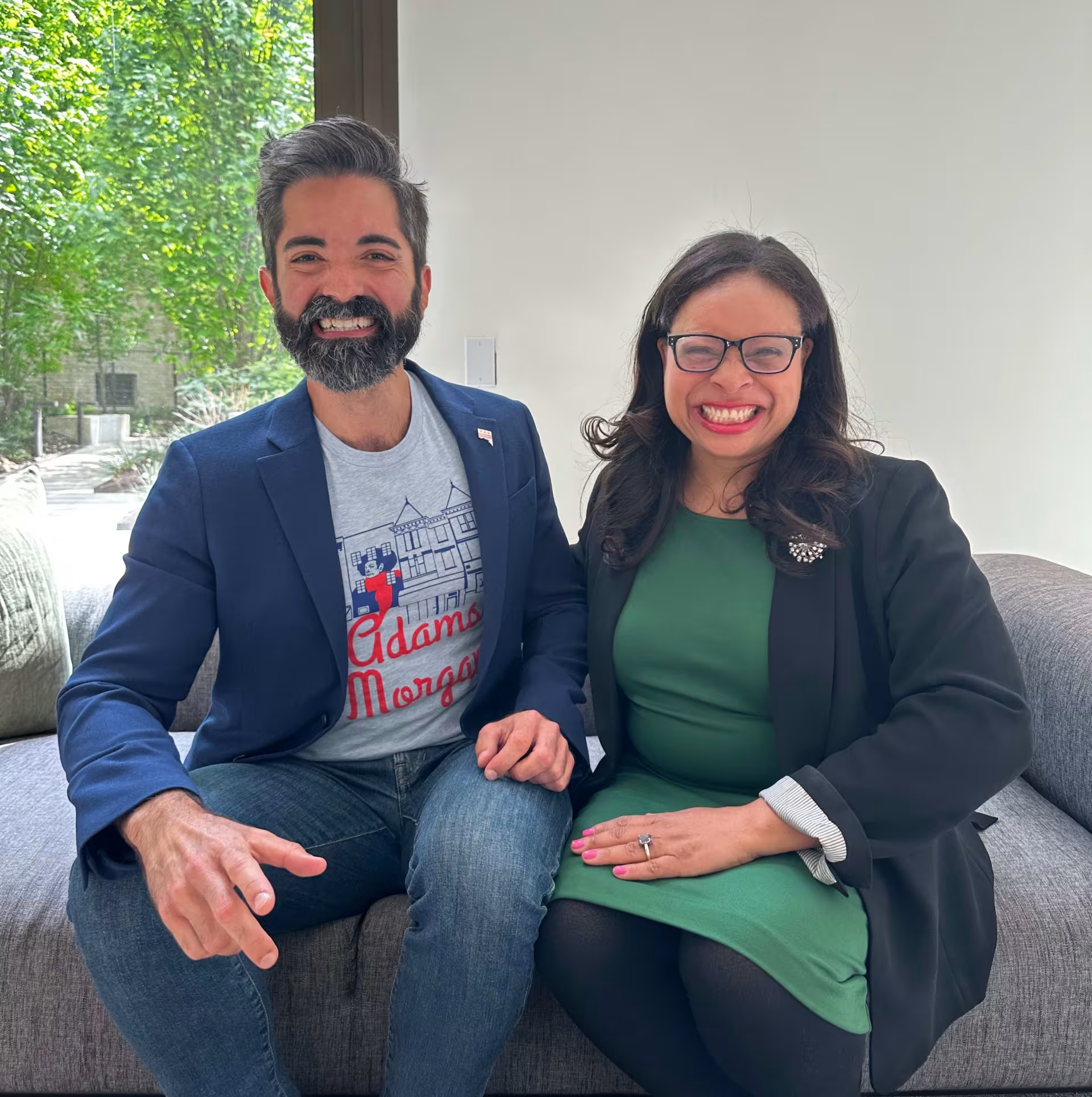


City Cast DC is conducting interviews with the front-running candidates in the D.C. primary election this year.
Here’s the transcript from the interview that executive editor and co-host Michael Schaffer did with former D.C. Councilmember Kenyan McDuffie, who is running for mayor. The interview has been lightly edited for clarity and was conducted prior to City Cast releasing its recent mayoral poll. You can also listen to the interview here.
Council member, thank you so much for being here with me.
Thanks for the invitation, man.
I'm glad you accepted.
Yeah, absolutely. Looking forward to the conversation.
You have spoken really eloquently about growing up in D.C. Stronghold was the neighborhood you used to live in. And you've talked about what it was like to be growing up here in the eighties and nineties. You said you've made bad decisions, you have friends who made bad decisions and that stuff happened to you. I'm wondering, looking at the city now, as a kid growing up as you did in a neighborhood like Stronghold… better place now? Worse place now?
I think it's better for a number of reasons in terms of safety more broadly across the city. I think the reputation of the city is better. I think the economy has grown in many ways that has afforded some opportunities to people. But I think it's uneven, frankly.
Depending on where you go and who you ask, you're gonna get a different answer about whether it's better, because in the process of this city growing over the last 20, 25 years, a lot of people have been displaced. A lot of people who perhaps could have benefited from some of the expanded job opportunities, new businesses, just some of the amenities that exist in downtown — they're gone, frankly.
So I think it's been a mixed bag depending on who you ask. But, D.C. in 2026 certainly feels safer than it did when we were growing up in the 1980s and 1990s.
Right, so you and I are about the same age. We grew up in the same city. It's been this kind of amazing run, right? We're 150,000 more people now than we were. Safety stats, a lot of the stats are much better. But what do you think could have been done differently, and maybe can start to be done differently?
There's this displacement you've talked about and those folks are gone, but there's also, I think, among a lot of people, a real sense of alienation. Like, all the nice stuff's not for me and I may not be able to afford to stay here.
I think a lot of the attention at the time [is from] where we saw sort of resurgence, revitalization, and I want to give a lot of that credit to the district's growth and financial turnaround to Mayor Anthony Williams. He deserves it. He laid out that vision of economic growth. He wanted to attract 100,000 new residents to the city. Some people laughed at him, and didn't think it was possible, and he succeeded. Every mayor and elected official in the city's bottom line, frankly, have benefited from that vision.
My vision's a little different because I think we need guardrails. We need economic growth with guardrails to try to avoid displacement. [I’m] thinking proactively and intentionally about how you engage communities that have lacked opportunity, communities that are still suffering from high levels of unemployment, violence, poor health outcomes. How does the city show up for them and demonstrate to them where they fit into the future economic growth?
So, wait. I know what a guardrail is on a highway. What does it look like in city government? What wasn't there that under Williams, under Fenty, under Gray, under Bowser, that could have been there, that was a guardrail that would've kept some of the displacement and inequality from happening?
So, the word ‘equity’ has become sort of a buzzword for a lot of people to use. Frankly, in some circles it's not used anymore because it's a lightning rod. But I think government must do its work through the lens of equity. I'm not ashamed to say and frankly, will lift up the need for the District of Columbia to do its work more specifically through the lens of racial equity.
The city has pretty robust set-aside programs that have focused, rhetorically at least, on equity. Those programs have continued through all of these pro-business mayors we've had. What specifically does that mean? Like, what policy change? What law change?
I'll tell you specifically what it means. A few years ago, I authored a bill that was passed and funded by the council called the “REACH Act,” for short. That acronym stands for “Racial Equity Achieves Results” Act. It established the Council's Office on Racial Equity, or “CORE” for short.
It was one of the first of its kind for city government to take a bill, do an analysis, use a racial equity impact assessment tool and say, "Hey, before you vote on this, here's what the potential impact is on marginalized communities, communities of color, Black, Hispanic communities, women." But it gives you some guidance. It gives you some resources. It does an assessment so that elected officials can see the potential impact before the vote.
That same office issued a critical commentary on extending the youth curfews, which you supported, which is a very divisive issue. They said, probably accurately, it was gonna hit Black kids a lot harder than it's gonna hit white kids who've got fancy backyards in the Upper Northwest.
Absolutely.
Should equity have figured into that and how so?
Oh, it does figure into it. That's precisely what the Council's Office on Racial Equity does. There is a Mayor's Office on Racial Equity that isn't funded and isn't utilized to the extent it should be to measure performance across agencies and to really gauge the impact of a government policy and law’s implementation on communities across district limits. Not just marginalized communities. But what is the impact?
So, the youth curfew is just an example. Which is why I believe that the curfew is a tool that should be used temporarily and not permanently. I think that's a contrast that I bring with the current mayor and her approach to addressing some of the things that are happening in the Navy Yard with teen takeovers, and I think in some of the candidates who are running for the Office of Mayor.
The curfew is appropriate on a temporary basis given the risks of those young folks who are coming down to the Navy Yard and other places. Sores, I mean hundreds of kids. You're finding guns, shots-fired incidents. My fear is that it only escalates where young folks who are excited, looking for things to do, want to be on social media, see it as fun and games. But there are real risks. There are serious risks of violence that we've already seen that can escalate when some young person brings a gun or some National Guards person, who's not trained to be a police officer, doesn't understand how to deescalate a situation and actually draws a weapon. So, I think we have to have a curfew as a temporary measure.
But going back to the city as it has changed in the last 25, 30 years… You got outta high school, you worked as a mail carrier, you're in Friendship Heights. All of a sudden, you're in this different neighborhood. It's much wealthier than the neighborhood you grew up in. One thing that hasn't changed is the inequality.
In this run of good statistics that the district has had for these 30 years under Williams, under Fenty, under Gray, under Bowser: What didn't they do that this focus on equity you're talking about would've gotten them to do? What did they do that that kind of focus would've prevented? Because it seems to me they decided, “We wanna make D.C. an easier place to be for rich people, for people who have a choice. And we're gonna make services better and we're gonna make it safer and everyone's gonna benefit and we'll get more and our tax base will grow.” Where in that set of things, where did they go wrong on the equity side?
Well, I think it would be an oversimplification to say they just got it all wrong. I think they did what they thought was best in terms of how to operate government, use the tools that you have to grow economy, create jobs, and try to connect folks. A lot of great programs around workforce development have been implemented and have been helpful to some people.
On the other hand, what does it look like to actually show up in those communities and ask them for what they think they need? You have challenges when it comes to education that I think are largely a byproduct of policies, racist and discriminatory policies. No fault to the folks who have been in office the last 20 years, but that created a city that concentrated wealth in certain communities and concentrated poverty in other communities.
So, if you are building a city and your focus is on downtown and you have elected officials taking pride in counting cranes but you're not making a connection to build housing that is affordable or you're not deconcentrating poverty intentionally in communities that are plagued by high unemployment, poor health outcomes, pick your—
Why didn't they do that? And did you push them to? I mean, you're on the council.
Oh, absolutely. Absolutely. We have. And you've seen some progress. I can point to specific things where I passed a bill that requires, every time the District of Columbia has a surplus, 50% of it is directed to the city's Housing Production Trust Fund, which is the primary tool that we use to preserve existing units of affordable housing and to build new units of affordable housing. We've built lots of housing over the last several years, and some of it has been deeply affordable—the lower end, 30 to 50% of the median family income. So you're seeing more people be able to access that type of housing.
I did a bill that says whenever you dispose of the city's land for the purpose of building multifamily housing there has to be [some units] set aside for affordable housing. Again, all the way up to that missing middle, 80% of the median family income. So we've done some things well and you've seen the city grow in a way that has been more equitable over the last decade or so, over the last 15 years.
I'm not trying to assign blame. That's not what residents of the District of Columbia want in their leadership. And that's not what I'm giving them. I'm giving them new innovative solutions to intractable issues that we face as a city, and frankly, cities across this country have faced over the last several decades.
It's a weird election because you're facing an opponent who has a very clear, articulated ideology. And you are saying, which I think most of your recent mayoral predecessors would say too, “OK, the market does some stuff well, but we need some guardrails.” It's not a message that people can go to the barricades for in the revolution. What is the Kenyon McDuffie ideology?
I would say that at a time where the District of Columbia faces a $1.1 billion spending pressure, where resources are thin, and we have a federal government, a really hostile administration that has cut federal jobs, that has reduced federal spending– you have a Congress that has treated the District of Columbia like a political football. It has cost us lots of money. Our bottom line is suffering. Our bond rating has been downgraded on Wall Street because they're saying we're too tethered to the federal government.
With all that as a backdrop, we need a fighter to push back against a federal administration. But we also need somebody who's pragmatic and understands how to deliver results for people in terms of delivery of core services, right? We need to keep the city safe. We need a police force that has more officers that are well-trained, and understand community-oriented-policing. We need to reduce the millions of dollars we're spending in overtime and boost morale out of a department that's felt depleted.
My approach to policing is grounded both in my training as a lawyer, civil rights attorney and in President Obama's justice department, traveling around the country, investigating police departments, offering technical assistance, making sure that it's community oriented. But also, my experience growing up in a city where the federal law enforcement converged on neighborhoods across the District of Columbia. I know what injustice feels like, to be arrested as a teenager in your own neighborhood.
What I'm saying is, I'm not gonna divest from the police like my primary opponent is saying. We're actually gonna support law enforcement and make it a place where they want to work, where they don't get burned out, where they show up in communities proactively and not just after 911 is called, where they know the streets and they know their beat and they know the senior citizens sitting on the porch so that when a crime happens, they can close out those cases at a higher percentage than what they're doing right now.
You say we need more cops and you wanna stop the drain. I mean, now there's another reason for the drain, which is the feds are trying to hire people away and offer more money.
That's right.
If you ask some of the sort of diehards and the police union, they will say that the demoralization of the police had to do with some of the reforms that passed after 2020. What do you think of that argument?
Well, I think that there is a serious morale issue right now at the Metropolitan Police Department. But there's also a lack of the tools that they need to do better recruiting. You mentioned that a lot of other regions, including the feds, ICE, HSI, are throwing $80,000 at officers. Well, we need to double at least the recruitment bonus that we're giving to officers to be in the Metropolitan Police Department.
But would you roll back any of the reforms that—I mean, congress has rolled some of 'em back already—but would you roll back any of the 2020 reforms?
I don't think the rollback is where you need to place the emphasis today. You need to place the emphasis on creating an environment where metropolitan police officers want to stay and retire. I think that has to do with hiring up the numbers so they're not getting burnt out. I think there needs to be better recruitment, double the hiring bonus from $25,000 to $50,000… having a mayor who cares deeply about the police force to make sure that it's strong.
Those officers are literally risking their lives every time they put on a uniform to protect and serve and we're gonna work with them to get the numbers up and ensure that we're addressing the burnout that they're feeling right now. We don't want them to be recruited away. It's the nation's capital. We want them to take pride in what they do. We also wanna make sure that they can show up in the rec centers, community centers, in other institutions, working with the faith community: partnerships that give them the ability to engage the community in a meaningful way so that their ability to do their jobs is just much better than what we've seen.
There's a counter argument, which is that–in particular we've heard it with the youth curfews, we've heard sometimes with the school resource officers—that the last thing kids, particularly kids in struggling neighborhoods, need is more policing of them. What's wrong with that argument?
I think it's important for people to understand that community safety and policing is really built on a foundation of trust and you don't establish that trust by simply responding after somebody calls 911. You certainly don't establish that trust by over-policing in a hostile, adversarial way in communities that feel like the presence of the police is intrusive. When I was growing up in the early eighties, that adversarial relationship didn't exist. I played basketball and football for the Metropolitan Police Boys and Girls Clubs when I showed up—
I think you're a little more athletic than me.
When I showed up to play, to hoop at the Metropolitan Police Number 10 Club at 14th and Clifton, that was a place you didn't go unless you lived there or knew somebody. But when you went inside the club, it was a safe haven.
But you went all the way over there from Stronghold?
I absolutely did. It was the best place to play. And you went inside that club and Officer Lynch was the first person to greet you. You went downstairs to practice, and Mitch Credle was on the force, right? So that trust was being established without me even knowing it.
When I went home to my neighborhood in Stronghold, my best friend's older brother was on the Metropolitan Police Department. So, my desire to be a civil rights lawyer in part was based on my desire to see justice in neighborhoods like mine. And I think policing is a delicate balance, but MPD does a much better job today than they did two decades ago for sure. In part because you had investigations by the Department of Justice's Special Litigation Section where I was employed, where you put in place policies and you form departments so they're doing policing that is community-based.
Yeah, consequences are important. Accountability is absolutely essential. But you also have to make sure that as a government you have accountability paired with opportunity in communities that have seen lots of crime and violence historically in our city. We know where these communities are. We know where a lot of these kids are coming from that are making some really bad decisions, that are engaging in violence. And we need policies that are “both and,” not “either or” when it comes to community safety.
We've seen things turn around though. We've seen policies turn around both at the council where we increased some of the penalties when it comes to pretrial detention. Some of the things that were changed, I supported. But I asked tough questions before saying yes to supporting some of those things. My principal opponent did not.
Let me try to represent it as accurately as I can: We have this situation where people have been accused but not convicted of a crime. They are kept in often terrible conditions in jail. This lands much harder on poor people. It is a classic case of non-equity. Why should we have a pretrial? The country seems to be moving away from that. Why was it a good thing?
We were in a state of crisis in terms of violence that we’re experiencing. The levels of gun violence, gun possession, use of deadly weapons, were at levels we hadn't seen in decades. And we needed to respond. We needed people to feel safe and to be safe. We needed to demonstrate the city was going to hold those charged and accused of crimes to make sure that we can ensure we had safe communities across the District of Columbia.
I think we have to be in a position as elected officials to make tough decisions and to assess decisions that we make, to make sure that they are viable and that they have the efficacy that we think they will have when we implement them.
So, we have seen crime go down over the last couple years to historic lows, and that's what community safety ought to be about. While things have changed over the years, you still have a bifurcated system. And when I'm mayor, we're gonna make sure that [community safety] is fully integrated and actually implemented with the intention that the NEAR Act had so that you can have the resources paired with the expertise and credible messengers and others who are embedded in these communities.
I want to jump back to housing. You mentioned, if you were to put more money in the Housing Production Trust Fund, what you want to do with that as mayor. There's a bigger question, a lot of advocates will say, “The real thing we need to do is make it so you can build, by right, in a lot more places or maybe everywhere.” Do you support that?
I do.
And that means cutting out the ANC’s and cutting out some of the zoning processes?
I don't think we should ever cut out our ANC’s or our community involvement. I do think we need to address zoning and some of the regulations that make it more difficult to build in the District of Columbia.
What do you think of that new planned land use map?
I think it didn't go far enough. We're talking about a 2050 plan. It's not nearly bold enough. We need to be able to build more, faster across the District of Columbia with every ward playing a part in how that happens, looking at how we build, as a matter of right, especially around transit hubs, around metros. Thinking about how we build townhouses, more multi-family across the District of Columbia, particularly in high need areas, around Connecticut Avenue, Wisconsin Avenue, other places, is very important to the future District of Columbia. As you think about the housing that we need to build across incomes, where we're deconcentrating poverty, not just building affordable housing in wards five, seven, and eight, or parts of ward six that already has high amounts of public housing.
I think a lot of the concern about housing is not just about poverty. It's about, “Where's my second grade teacher gonna live?” It's the person who makes a good living, and she's worrying, “When I want to have babies and get married and have a bigger house, D.C. is not gonna be the place I can afford.” What do you do about someone like that?
You build housing for everybody. Which is why I have a “housing for every generation” plan that looks at, not only building more affordable housing, including deeply affordable housing, but building that missing middle for your teachers, for your first responders, police officers. We want them to be able to live where they work. So, making sure that we are building housing for middle income individuals and families is absolutely essential to what the future of the District of Columbia needs to look like, which is why we need to reduce barriers, zoning, regulatory, and otherwise.
We can't have people, NIMBY’s, litigating their way to slowing down projects. There are real costs associated when we allow that to happen. I can say that both as a former council member of Ward Five, and personally as somebody who lives on North Capitol Street. Across the street is McMillan Reservoir. That's a property, 25 acres, that Washington D.C. purchased from the federal government in 1987 for the purpose of economic development. And yet, that project was stalled over and over and over again.
It's been a long 39 years.
We broke ground in 2016 only to have a lawsuit that slowed that project down, and only for the ground to be broken, but six years later. We're now only starting to see the townhouses in the community center and the six acre park, and the homes are selling today for much higher prices than they otherwise would've sold for had we moved with a level of urgency, with reduced barriers when that was originally proposed 20 years ago.
Well, here's the thing that you also know 'cause you were a former Ward five council member, which is that a lot of people who live in the neighborhoods now are gonna come to you and say, "I don't want a bigger place going up next door. I moved here 'cause I thought it was a lot of nice shade and I could park wherever I wanted." And they're gonna say, "I'm a citizen. I'm gonna use the legal system to try to get my way."
It sounds like what you're saying is that they should go pound sand. It's tough. Life changes. How do you do that?
The District of Columbia is a world-class city. In order to really fulfill that promise of protecting our beautiful diversity, we need more housing. The demand is there. We need to make sure that supply meets it. I'm not gonna tell 'em to go pound sand. I'm gonna invite them to a meeting where I lead with a vision of building more housing across the city. That means in every ward. That means reducing the barriers to zoning. That means more townhouses and more multi-family. It means that if you think you shouldn't be a part of what that looks like, you make the case.
I'm gonna make a much stronger case that we need housing across our city, including more density in places that don't have it, including higher heights in places that would be appropriate for that, including on major thoroughfares that have infill opportunities to build housing. We have to do it and I'm gonna lead on that because our city deserves it and the people who want to be here deserve it. The people who are already here who want to afford to stay here deserve it as well.
So the YIMBYs would say, “The only way you can stop this litigation that slows everything down like McMillan is by upzoning the heck of the city.”
You have to do it. And, that's why the Future Land Use Map falls short.
Butthat means the ANC’s lose their ability to say no.
No, they'll have the ability to say no, but they won't have it in the same way that slows down projects or progress. Progress means that we are upzoning. Progress means that you build more housing. Progress means that you do it in communities that historically have been homogeneous because of the racist, discriminatory, land use zoning, housing policies that have concentrated wealth in certain communities and concentrated poverty in other communities in the District of Columbia.
Since [the time when] you and I were both growing up, a lot of the racial mixing of neighborhoods has happened the other way, where people with money move into formerly Black, middle class or working class neighborhoods. Some people might say, “Well, this is great. People who live in these neighborhoods, they're able to capitalize on their investment. They've worked hard all these years. If they wanna sell for a lot of money, good for them.” Other people would say, “Now, this is gentrification and it makes people feel unsafe and unwelcome in their own city.” Where are you on that?
Where I am on that is Union Market, where you make an investment as a city to support development of a place that has its historic spine still there, but you build housing and you build a community where people can live, work, play, and raise a family. You've got great restaurants, nightlife happening there. You've got great housing options there. And yet, you can still go there and get things that are culturally appropriate and relevant for people who have restaurants and retail shops across the city.
That's what I think when I think of those types of arguments. I respect people who feel like the city's developed in a way that didn't have them in mind. I'm representing them. I'm running for them, because I think some of that is true. We've seen where communities haven't felt like they've been at the table. I'm running for mayor to make sure that people in communities that have been neglected can see themselves reflected in the future prosperity of our city.
Last housing question: Your opponent has cited a much bigger number for her target of how many housing units she wanted to build than yours. Why is yours smaller?
Well, it's not that mine is smaller, mine is realistic. The Washington Post has actually called her plan unrealistic. If you talk to any housing expert, they'll tell you the same thing, because they know that even at our height, during some of the best times that we've had over the last decade, the city has, on average, built about 5,500 homes.
There's no way she's gonna build 72,000 units of housing. It's just not gonna happen. What I'm not gonna do as a candidate, especially as an elected official, is to sell voters on false promises. I lead with integrity in this work.
I think people who live in the District of Columbia, and anywhere else for that matter, are turned off by politicians who are willing to do and say anything just to get elected. That's never been me. And I'm not gonna sell people on false promises. 72,000 units of housing is a false promise that she will never be able to execute on.
One thing builders say is that they don't want to come in and build stuff in D.C., in part because of the laws here that make it really hard to put out people who don't pay the rent. I know you're a builder, you got a mortgage to pay. Should we change those laws? Should we make it easier to put people out?
Here's the reality. I supported the RENTAL Act. My opponent did not. It made some slight improvements, some of which have yet to be really felt in our housing community, which is why investors don't have confidence in our market today, which is why we cannot build the housing that we need, because we can't get the capital necessary.
It's why, right now, even our mission-driven non-profit housing organizations, some of the larger ones, are selling assets. Right? We have an environment right now where we can't even preserve some of the affordability that we need because of the laws that are on the books. And we do need to change some of those laws.
We shouldn't be the hole in the donut when it comes to housing and when it comes to landlord-tenant policies. People can, and they have, put their capital in other places in the region because of how difficult it is to be a housing provider in the District of Columbia.
It shouldn't take a year or two or three in some cases, (extreme cases, albeit) to get somebody who's not paying their rent. I'll be the first to protect our tenants, and I'm gonna lead with that every day of the week. But, we also have to have a system that's fair on either side. This is essentially social combat that has obligations both for landlords and for tenants. We simply can't continue to be the hole in the donut that takes way too long to evict somebody who is not paying their rent, particularly those bad actors who can afford to, and are simply choosing not to.
It's a problem for the District of Columbia and it's costing us in our inability to build the housing that we need.
One of the things about this housing unit debate that's weird is that I'm looking at the same numbers as you are about the number of jobs and what has happened. It's like we're Detroit and GM is closed and firing people, which is with the federal government. The latest: The Bureau of Labor Statistics said the DMV in general has lost 103,000 jobs in the first year of the Trump administration. About 40% of those are in the District of Columbia.
The most obvious fix that people are talking about is to do things to make the District of Columbia more attractive to private sector to diversify the economy. On the other hand, it's pretty tough at a time when a lot of people are struggling to throw money and benefits at already wealthy private companies. Where do you come down in that?
That's precisely why, now more than ever, we need a mayor who understands that Washington D.C. needs to mean business. It can't just simply be rhetoric in order to get elected. And I mean business. I'm gonna be a pro-growth, pro-worker, pro-predictability mayor, so that we are focused like a laser on growing our economy.
We do need more jobs and you are not going to get more jobs expanding the federal government at a time where they're reducing and cutting jobs. People have been DOGEd and spending's been reduced. We're also not going to expand our economy by expanding the District of Columbia local government.
We're going to get the growth that we need by creating an environment that has a better business climate and by attracting more people in more small business starts in the District of Columbia and attracting more large employers.
The argument that I hear people making is, “People need childcare in this city. People are having a hard time with rents in this city, and we should be helping them out with that. And the way to do it is to tax profitable companies.” That might also scare some of them off. Where are you on this?
That's a way to run companies out of town, right? You create that environment where you default to raising taxes and it's the quickest way to have people and businesses leave Washington D.C. at a time where we need them to come here.
I think the best way to attract new people and new businesses is to take care of the people in the business you already have, not tax 'em out of town. And we're gonna focus on making it easier—
Even if that means saying no on expanding daycare?
We're not saying no. We're saying that we're gonna prioritize making childcare more affordable by doing what we do well, even better, and with a greater sense of urgency. We're gonna prioritize it in a budget—I am as mayor—our childcare tax credit to make sure that it's fully funded. We're gonna prioritize PKEEP, a very important program that lowers costs for childcare across the District of Columbia, and we're gonna prioritize pay equity frankly, to make sure that we can pay our childcare workers.
You said you're gonna prioritize pay equity. The mayor has proposed in her budget zeroing out the so-called, "Pay Equity Fund." This gives tax money to private daycare operators to improve the pay of their teachers. Her argument is the same one you've made which is, “You can only keep these things if you start boosting taxes and stuff on the businesses, and that's gonna run them out of town.”
You have to look across government and hold yourself more accountable for how you're spending money. I think the mayor, if she had her way, she would hire more officers across the District of Columbia, and we need to conclude that environment, as we talked about, to be able to do so. But we're spending too much on overtime at MPD and some of the other agencies. But MPD is the main culprit, right?
If you think about the decade from 2010 to 2020 and MPD was using about 500,000 hours in overtime at a cost of about $30 million to taxpayers. That's a lot. But if you think about the last six years, that number's quadrupled. We're spending almost 2 million hours of overtime at a cost of about $120 million. We have to address that spending and hire the offices that we need, boost morale, take the savings and redirect 'em. Then you use those savings in a way that is smarter, where you can prioritize programs like the child care tax credit, like PKEEP, and pay equity.
One of the refrains that people who don't like Kenyan McDuffie use– and I thought of it when you talked about treating businesses well who are already here in the name of attracting more– is that your administration will be Bowser number four. Are they right about that?
No, they're absolutely wrong.
What's going to be different?
They likely don't know my record. They likely don't know that I've been an independent-minded council member for 13 and a half years, and that I have one of the most progressive legislative records of any council member in years. I was the author of comprehensive campaign finance reform and comprehensive ethics reform. I authored criminal justice reform.
I put bills in place that have directed hundreds of millions of dollars to affordable housing. I've done the first guaranteed basic income program in the city's history that directed cash assistance to pregnant and expecting moms in Wards five, seven, and eight. And I did one of the first in the nation baby bonds bills that created trust funds for babies born into cycles of generational poverty in Washington D.C., which the mayor defunded.
What are some of the things she's done wrong on big picture stuff?
Well, I mean, I just gave you an example. Baby bonds, right? The Child Wealth Act was transformational when I authored it in 2021 and fully funded it for fiscal year 2022, to go into effect on October 1 2021.
Any baby in a Medicaid-eligible family was gonna get a trust fund of a thousand dollars in an interest-accruing account so that when they turned 18 years old in Washington, D.C., they had $25,000, $30,000, $35,000 sitting in an account waiting for them. [It wasn’t] to make them rich, but to give them resources to be able to invest in themselves, to perhaps start a small business, maybe put some money down for college or take up a trade, get a certification to compete in the tech industry. Those things are incredibly important. They provide hope to people who are born into cycles of generational poverty in Washington D.C.
She couldn't see the vision and did not support it. When I'm mayor, I'm gonna make sure that we fully fund that because I know what it's like to be 17 years old in this city and to have no hope, to not understand how you're gonna take care of yourself. I think that we need to, as a city, be bold and innovative when it comes to attacking poverty because we still have one of the largest racial wealth gaps of any city in the United States, right here in our nation's capital.
One of the things about your campaign is you've had this refrain about Janeese Lewis George, that there's out-of-town ideas and out-of-town stuff and New York stuff. The city's changed a lot since we were kids. There's 150,000 new people, a lot of 'em from somewhere else. Are you saying ideas from out of town are bad?
Oh, I'm not saying ideas from out of town are bad. I'm saying empty promises are bad. I'm saying, making things up for the purpose of getting elected that you will never be able to implement as an elected official is bad. It is the type of politics that turns people off so that they disengage. And I'm for engaging with voters directly and being honest with them about the state of affairs.
Right now, the city is seeing decline in its local economy largely due to the federal government. We're experiencing a Trump-induced recession right now. So, I'm gonna put in place policies that are perhaps more pragmatic, perhaps won't get as many clicks on TikTok, but they're gonna work for hardworking families across the District of Columbia to help grow our economy, to attract businesses, and create the jobs that those young folks who are trying to find their way will be able to compete for. We're gonna put the programs in places that train them up. We're gonna make sure that these young folks who graduate from our schools are not scared of AI, that they understand it and know how to use it. We're gonna retrain and upskill our displaced federal workers so we truly are the talent capital of this country, and we have to do that in order to grow our economy.
We have one of the largest regional economies of any region in the country, and it's largely because we have one of the most educated populations of any region in the economy. We have to retain that talent but we also have to produce the jobs that are gonna keep those people here. That's what my focus is on: we need leadership that's gonna fight a hostile administration, protect people from ICE, get rid of the cooperation between MPD and ICE and HSI, but also understand how to work with the federal government to do things like RFK, to expand Union Station. Right? To attract businesses, to build the housing that we know we can actually build, but not over-promise just to get elected.
You mentioned the Trump of it all. The president is a mercurial, difficult person for D.C. We've got Congress currently run by a Republican party where there's a lot of members who see a lot of upside in just beating up on D.C., insulting D.C.
Mayor Bowser's way of dealing with this is that she kind of sucked up to them. She played nice. She bit her tongue when I'm sure a lot of politicians would have raged, "Don't you dare insult my city or my constituents." She might say, we prevented things from being a lot worse. What's your feeling about that? Would you do the same thing?
I would not do the same thing.
What would you do differently?
What I'm gonna do differently on day one is to get rid of the executive order that allows cooperation between the Metropolitan Police Department and ICE. We don't have to do it.
What if the response to that is, “We're cutting off all your money”?
We'll have to deal with that when it happens, but that's a hypothetical though, Mike.
What I know is we are not New York, we're not Chicago, we're not San Francisco when it comes to engagement with the federal government. We are a product of the Constitution, article one, section eight, clause 17, that gives all power to Congress and we have limited home rule.
What I'm saying is that I'm going to work with the federal government where possible, but I'm gonna fight back like hell where necessary. Right? And I'm gonna defend our residents rights, including their constitutional rights. I'm gonna defend to make sure that we are ensuring justice and fairness when it comes to engagement with the federal government, particularly federal law enforcement. We do not need ICE or HSI in Washington, D.C.
What does it look like to end that cooperation? On a day-to-day basis, what would be different?
Well, I'll say this in talking with the National Guards, people that I've talked to, they don’t want to be here. They're following orders. They know they're not trained to be police, they don't want to police. They're being put in a bad situation.
It's bad policy and it's bad for the city because their presence including, and especially the presence of ICE and HSI and Homeland Security Law Enforcement, is eroding the trust that we've worked hard for the Metropolitan Police Department to build over the years. It makes people less safe ultimately, if they don't trust law enforcement.
I used to do a little boxing in the neighborhood. My dad put gloves in our hands really early on, and one of the things he would tell us about was, "In a fight, you never lead with your chin."
I'm not picking fights with Trump or the federal government. What I'm saying is, the reality is, I know how to finish fights. You strategically approach the relationship with the federal government so you get everything you need from the federal government to take care of Washington, D.C.
I supported Brian Schwalb's lawsuit against Trump. I looked at it, thought it was viable, and I supported it. That's the difference that you get with Kenyan McDuffie as mayor.
What's one thing you hope people will take away from this?
That there's only one candidate in this race for mayor of Washington, D.C. who's prepared on day one to fight back against Trump in a hostile federal administration and deliver a city that works, manages a $21 billion budget in a way that keeps people safe, that invests in education and quality schools, both D.C. public schools and D.C. public charter schools, and invests in businesses that create jobs and connect our residents to those jobs. I'm gonna be prepared to do that on day one, and I'm not gonna sell this city or its residence on false promises.
What do you think is the biggest misperception of you?
I think you've just articulated it, that I'm somehow just pro-business and anti-worker. The reality is, this is a campaign. My opponents wanna distort who I am and they wanna distort my record.
I am a son of this city. I am a husband to my beautiful wife of 20 years who's also a native Washingtonian, a father to two beautiful daughters. I am a person who loves this city. I'm not a politician, although I may fit the textbook definition. I am a public servant to my core. And this work that I do is because service is my passion and is my purpose.
Kenyan McDuffie, thank you so much for being here.
Thanks for having me.
Elissa Castles, Laura Tsutsui, Julia Karron and Annie Rees contributed to this transcript.